Overview & Specifications
What Is a Roll End Tuck Front Box?
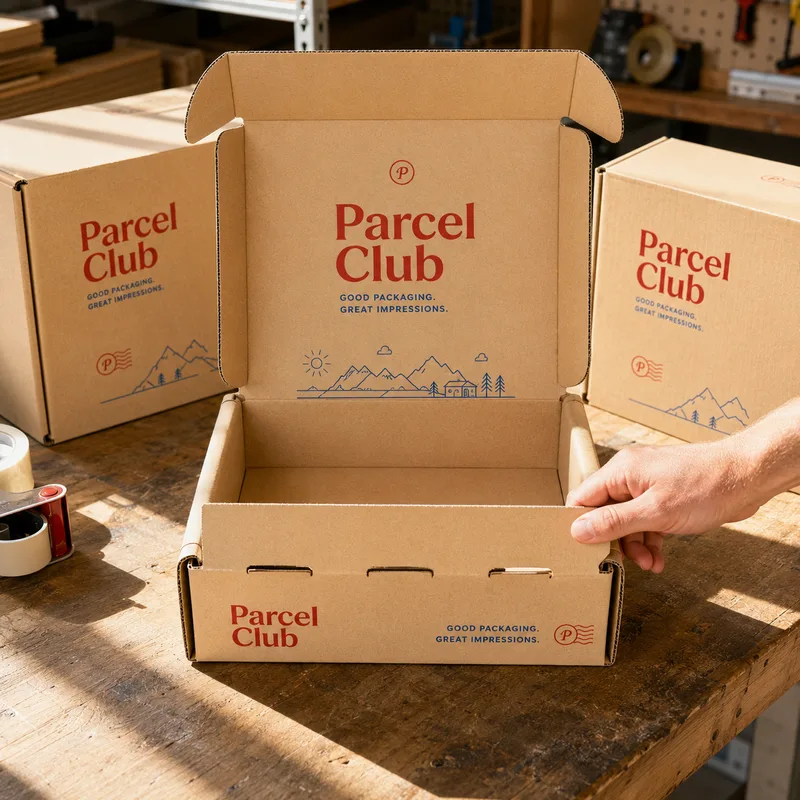
A roll end tuck front box, often shortened to RETF, is a one-piece folding mailer whose walls roll over into a double layer of board and whose attached lid closes toward the front, where its tuck flap engages the front panel. The engagement at the front is the defining feature: the lid is held by the front panel rather than only by friction inside the wall.
How the Front Tuck Locks
The format works through three linked features.
01
Rolled Front Panel
The front wall is formed from a double layer of board, giving the tuck a stiffer panel to engage.
02
Lid Tuck and Locking Tabs
The lid reaches the front edge of the box, where its tuck engages the receiving panel. Some dielines add small locking tabs and slots; tab shape, slot position and fit follow the approved dieline and board.
03
Receiving Front Edge
The closed front reads as one clean edge, with the tuck seated at the front rather than hidden at the top.
Anatomy of a Roll End Tuck Front Box
01
Lid
Attached top panel; folds toward the front.
02
Front Tuck
Lid flap that engages the front panel.
03
Locking Tabs
Optional tabs and slots, where the dieline includes them.
04
Rolled Walls
Layered, double-thickness walls.
05
Base
Floor that anchors the rolled walls.
The front edge is the first surface the hand touches, so it suits a logo, an "open here" cue or a short message. Keep fine detail clear of the tuck slots and roll lines.
Tuck Front vs Tuck Top
The two attached-lid formats look alike when closed; the difference is where the lid is held.
| Attribute | Roll End Tuck Front | Roll End Tuck Top |
|---|---|---|
| Where the lid is held | Front tuck engages at the front-facing edge | Tuck-top interaction at the top |
| Closing feel | Positive seat at the front edge | Friction tuck at the top |
| Front edge | Clean edge with the tuck at the front | Rolled front wall below the lid |
| Packaging Dock variants | None listed | All 8 application mailers |
Application guide
When Is a Roll End Tuck Front Box the Right Choice?
A roll end tuck front box suits DTC shipments, subscription and sample boxes, apparel and PR kits where the opening point should sit at the front edge and be part of the presentation. It opens and closes repeatedly, so it also works for boxes kept for storage.
01
Repeatable
Repeatable Front Close
The front engagement creates a repeatable mechanical close when board and tuck geometry are properly matched.02
Front
Front Edge as a Brand Surface
The closing action happens at the front, so the front edge and inside lid both become part of the reveal.03
Same
Same One-Piece Efficiency
Like other roll-end mailers, it ships flat and folds into shape at the bench, with no separate lid.04
Alternative
When Another Format May Fit Better
For Packaging Dock's standard ecommerce mailer, the base of all its application mailers, choose the Roll End Tuck Top Box. For a removable lid, see Roll End Boxes with Lid, and for an interlocking multi-flap closure, the Roll End 3 Flap Lock Box.
Roll End Tuck Front Box Specifications
Custom roll end tuck front boxes are specified around front-tuck geometry, board and flute, inside dimensions, inserts, print coverage and packed weight, with the final lock-tab interaction defined on the approved Packaging Dock dieline for each size.
| Specification | Available Configuration |
|---|---|
| Product Type | One-piece roll-end mailer with front tuck closure |
| Category | Mailer Boxes |
| Dimensions | Custom inside L × W × D, built around the product, insert and closure geometry |
| Core Construction | Single die-cut blank with double-layer rolled walls and an attached lid |
| Closure | Front tuck per approved dieline; tape or adhesive strip where shipping requires |
| Board | Corrugated (E-flute, B-flute or other flute by project), white SBS, kraft or recycled paperboard; metallic, holographic, pearlescent or textured cardstock |
| Board Thickness (quote form) | Paperboard (18–24 pt), E-flute corrugated, B-flute corrugated, or not sure, advise me |
| Inserts | Paperboard, corrugated, foam/EVA or molded pulp; thermoformed PET/PVC trays also offered for mailers |
| Print Coverage | Exterior only, exterior + interior lid, or full inside and outside |
| Print Methods | Offset, digital, UV, screen or flexographic printing; CMYK and Pantone spot colors |
| Coatings and Finishes | Matte, gloss or soft-touch lamination, aqueous coating, foil stamping, emboss/deboss, Spot UV and raised 3D UV |
| Starting Price | From $1.45 / unit; final price depends on size, board, print coverage, inserts, finishes and quantity |
| Minimum Order | 500 units |
| Standard Production | 7 days from approved proof |
| Rush Production | Available on request |
| Shipping | Ships flat, USA and worldwide |
How Tuck Front Mailers Compare to Other Mailer Structures
All four share rolled walls; the comparison below covers what changes when the lock moves to the front.
| Attribute | Roll End Tuck Front | Roll End Tuck Top | Roll End with Lid | Roll End 3 Flap Lock |
|---|---|---|---|---|
| Lid | Attached | Attached | Separate | Attached flaps |
| Lock point | Front-facing edge | Tuck-top interaction | Lid-over-base fit | Three interlocking flaps |
| Re-opening | Releases and re-seats | Releases and re-tucks | Lifts off and back on | Unlock sequence in reverse |
| Pieces | One | One | Two | One |
| Best fit | Front-locking presentation | Everyday ecommerce mailers | Shoebox-style reveal | Deliberate locked opening |
What Size Roll End Tuck Front Box Do You Need?
Size from the inside out: measure the packed product or insert, add clearance, and quote the box by inside length × width × depth. The front tuck needs its own depth on the lid flap, so very shallow boxes are checked on the dieline to keep the lock engaged.
How Product Size Becomes Box Size
The figures below are planning references, not fixed manufacturing rules; final allowances depend on product shape, insert, board and flute.
| Step | Typical Allowance |
|---|---|
| Product to inside dimensions | Add about 3–6 mm (1/8–1/4 in) to length and width, 2–5 mm to depth |
| Insert present | Inside dimensions follow the insert's outer size |
| Rolled walls | Outside length and width grow by about four board thicknesses |
| Lid and base | Outside depth grows by about two board thicknesses |
Board and Flute Reference
| Board | Typical Thickness | Typically Suited To |
|---|---|---|
| Paperboard, about 18–24 pt | About 0.45–0.6 mm | Light products or boxes inside an outer shipper |
| F-flute corrugated | About 0.8 mm | Light items, fine print surface |
| E-flute corrugated | About 1.1–1.6 mm | Most printed mailers |
| B-flute corrugated | About 2.5–3.2 mm | Heavier packed weights |
Important: Thickness figures are references only. The front tuck must engage reliably at the chosen board, so lock fit, board and flute are confirmed on the dieline and, where it matters, a sample. No fixed crush or drop rating is stated.
If you are unsure, share the product dimensions and weight with the quote request, and the box is sized around them.
Does Box Depth Affect the Front Lock?
Yes. The tuck and its tabs need enough front-panel height to seat; on very shallow mailers the dieline balances tuck length against depth so the lid still locks. Carrier billing also rewards a tight fit: UPS, FedEx and, for parcels over 1 cubic foot, USPS charge by dimensional weight at a 139 divisor.