Overview & Specifications
What Is a Flat Paper Bag?
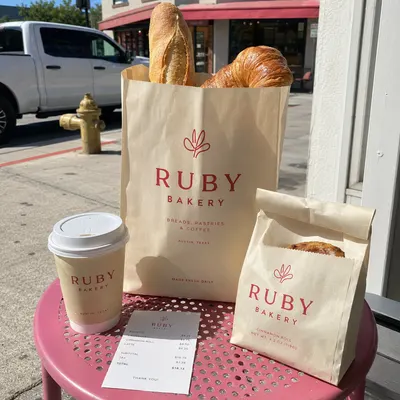
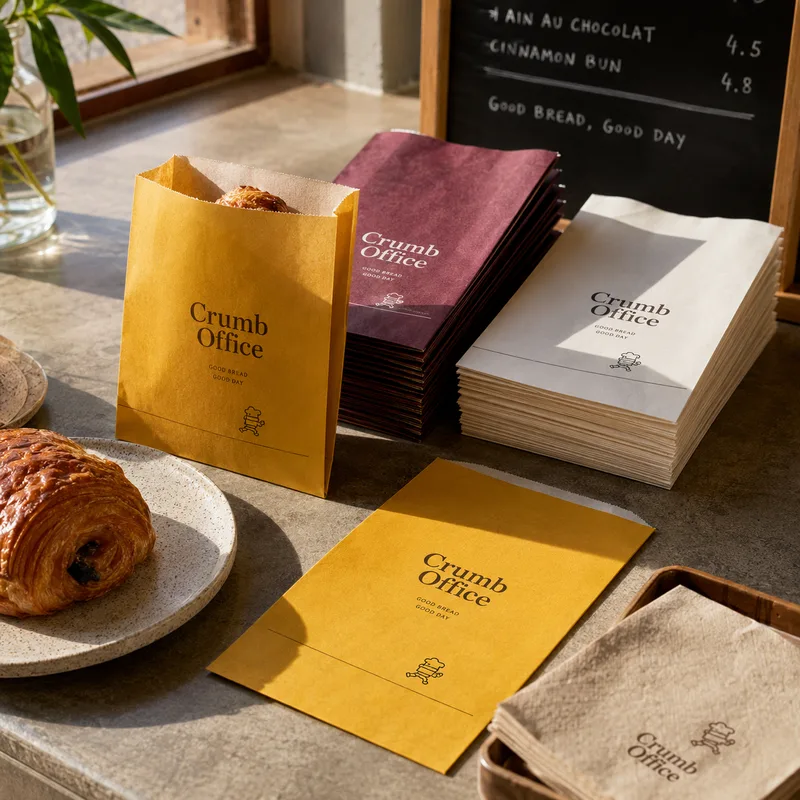
A flat paper bag is the simplest paper bag format: two flat panels sealed along the sides and bottom, with an open top and no side or base gusset. It has almost no depth, so it holds cards, stationery, small textiles or flat bakery items close to their own shape, and it does not stand on a base.
How a Flat Paper Bag Works
The format works through three production details.
01
Flat Front and Back Panels
The bag is made from paper folded or joined into a front and back panel, giving a slim profile with no expanding sides.
02
Sealed Sides and Base
The side and bottom edges are glued or sealed, leaving the top open for filling.
03
Open Top
The top stays open unless another feature is added, such as a fold-over flap, sticker seal or tin tie.
Anatomy of a Flat Paper Bag
01
Front Panel
Main logo and branding face.
02
Back Panel
Second print surface or back seam.
03
Side and Bottom Seams
Close the bag around the product.
04
Open Top
Filling edge, plain or with a thumb cut.
05
Optional Closure
Flap, sticker or tin tie where specified.
Front and back panels are flat and uninterrupted by gussets, so logos and copy sit edge to edge; seams are marked on the dieline.
Flat Paper Bag vs Paper Tote Bag at a Glance
| Feature | Flat Paper Bag | Paper Tote Bag |
|---|---|---|
| Gusset | None | Side and/or base gusset |
| Handles | None, unless engineered handle treatment is specified | Twisted paper, rope, die-cut or ribbon |
| Stands upright | No | Yes, on its base |
| Best for | Thin, lightweight items | Boxed and multi-item purchases |
Application guide
When Is a Flat Paper Bag the Right Choice?
A flat paper bag suits thin, lightweight products that do not need a standing base or handles: cards and stationery, small textiles and accessories, flat bakery items in suitable food-contact paper, and samples or inserts, especially where counter or storage space is limited.
01
Compact
Compact Flat Storage
The bag stays flat before filling, so stacks fit at counters and in fulfillment areas with limited storage, and each bag is opened as it is packed.02
Simple
Simple Packaging for Thin Products
Cards, small textiles, flat bakery items and stationery fit without a broad base or extra depth.03
Direct
Direct Branding Surface
Front and back panels give a clean area for logos, product information and simple campaign artwork.04
Alternative
When Another Format May Fit Better
If the purchase is boxed, bulky or carried by hand, choose a Paper Tote Bag with gussets and handles. For rigid presentation around a product, see Custom Mailer Boxes or Tuck Boxes.
Flat Paper Bag Specifications
Custom flat paper bags are specified around width and height, product thickness, paper type and weight, seam and top finish, closure, print coverage and finishes, with the panels and seams set on a custom dieline for each size.
| Specification | Available Configuration |
|---|---|
| Product Type | Non-gusseted paper bag |
| Category | Paper Bags |
| Structure Role | Core paper bag structure: flat, non-gusseted |
| Dimensions | Custom width × height, built around the product's size and thickness |
| Core Construction | Flat front and back panels sealed at sides and base, open top |
| Expansion | Minimal; no side or base gusset |
| Paper | Standard or heavy-duty kraft, white art paper, recycled paper; metallic, holographic, pearlescent or textured paper |
| Paper Weight | About 50–150 gsm, matched to the product and handling |
| Closure | Open top; optional fold-over flap, sticker seal or tin tie |
| Handles | None, unless an engineered handle treatment is specified |
| Add-ons | Die-cut window (with or without film), grease-resistant paper where suitable |
| Print Coverage | One side, both sides or full wrap |
| Print Methods | Offset, digital, screen or flexographic printing; CMYK and Pantone spot colors |
| Coatings and Finishes | Matte, gloss or soft-touch lamination, aqueous coating, foil stamping, emboss/deboss, Spot UV and raised 3D UV |
| Performance | Weight and tear resistance depend on paper grade, dimensions and product load |
| Starting Price | From $0.65 / unit; final price depends on size, paper, print, finishes and quantity |
| Minimum Order | 500 units |
| Standard Production | 7 days from approved proof |
| Rush Production | Available on request |
| Shipping | Ships flat, USA and worldwide |
How Flat Paper Bags Compare to Paper Tote Bags
| Attribute | Flat Paper Bag | Paper Tote Bag |
|---|---|---|
| Construction | Two flat panels, no gusset | Gusseted geometry, side and/or base per project |
| Depth | Slim, close to the product | Set by the gusset |
| Handles | Not standard | Standard |
| Packed shape | Flat | Stands on its base |
| Typical paper | Lighter kraft or art paper | Kraft or art paper; base insert optional |
| Best fit | Cards, stationery, flat items | Boxes, apparel, gift sets |
What Size Flat Paper Bag Do You Need?
Quote by width × height, measured flat. Because there is no gusset, the product's thickness takes up part of the width and height, so share the product's thickness as well as its face size.
There is no fixed size list: any practical size is built to order, across the full paper range below.
How Product Size Becomes Bag Size
The figures below are planning references, not fixed manufacturing rules; final allowances depend on product thickness, paper and closure.
| Step | Typical Allowance |
|---|---|
| Product width to bag width | Add the product thickness plus about 10 mm (3/8 in) |
| Product height to bag height | Add the product thickness plus about 20–30 mm for the opening or flap |
| Fold-over flap | Add the flap depth to the height |
| Several flat items | Size to the stacked thickness |
Paper Weight Reference
| Paper | Typical Weight | Typically Suited To |
|---|---|---|
| Light kraft or white paper | About 50–70 gsm | Cards, tissue-wrapped items, flat bakery items |
| Standard kraft or art paper | About 80–120 gsm | Stationery, small textiles, accessories |
| Heavy-duty kraft or art paper | About 120–150 gsm | Heavier flat items and repeated handling |
Important: These are reference figures. Weight and tear resistance depend on the paper grade, dimensions and product load, so the bag is confirmed on a sample with the actual product.
If you are unsure, share the product's width, height, thickness and weight with the quote request, and the bag is sized around it. For products near the depth limit of a flat bag, a sample confirms the fit before production.
Do Flat Paper Bags Stand Upright?
Not as a defining feature. With no base gusset, the bag lies flat when filled; for a bag that stands on its base, choose the Paper Tote Bag.