Overview & Specifications
What Is an Auto Lock Box?
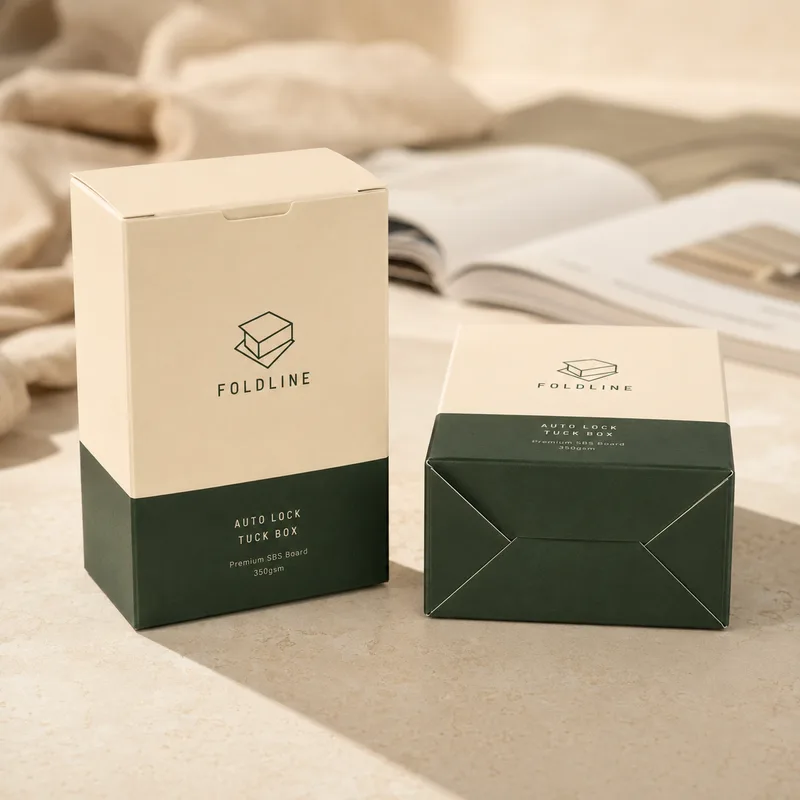
An auto lock box, also called a crash lock bottom or tuck top auto bottom carton, is a paperboard folding carton whose bottom flaps are partly glued together in production. The carton arrives flat; when it is pushed open into a rectangle, the glued bottom flaps swing into position and lock, forming the base in one motion. The top usually closes with a standard tuck.
How the Auto Bottom Forms
The format works through three production details.
01
Pre-Glued Bottom Flaps
The bottom flaps are glued to each other at set points during production, while the carton is still flat.
02
One-Motion Setup
When the packer squares the carton, the glued flaps are pulled into position and lock into a flat base without extra folding.
03
Tuck Top
The open top takes the product, then closes with a tuck flap and dust flaps.
Anatomy of an Auto Lock Box
01
Auto Bottom
Pre-glued flaps that form the base on opening.
02
Glue Points
Set on the dieline to control how the base forms.
03
Side Seam
Glued in production.
04
Tuck Top
Re-openable closure.
05
Main Panels
Front, back and side print surfaces.
The base folds from several flaps, so bottom-panel artwork is limited to a simple mark or barcode area set on the dieline. Keep glue zones free of lamination where the adhesive needs bare board.
Auto Lock vs Snap Lock at a Glance
| Feature | Auto Lock | Snap Lock |
|---|---|---|
| Bottom made | Pre-glued in production | Folded by the packer |
| Bottom setup | One motion as the carton opens | Flaps folded in sequence |
| Glue needed at packing | None | None |
| Bottom setup at packing | Forms on opening, no bottom folding | Flaps folded and interlocked by hand |
Application guide
When Is an Auto Lock Box the Right Choice?
An auto lock box suits retail products packed in volume where bottom setup time adds up, and products that call for a pre-glued locked base, such as cosmetics, bottles and jars, small consumer goods, confectionery cartons and promotional items.
01
Faster
Faster Bottom Setup
The base forms as the carton opens, removing the bottom folding steps at every unit.02
Consistent
Consistent Base Formation
Because the bottom is glued in production, every carton forms the same base instead of relying on each packer's folding.03
Pre-Glued
Pre-Glued Locked Base
The bottom is glued in production and locks as the carton is squared up, instead of closing with a tuck flap. Suitability for a given product depends on board, size and packed weight.04
Alternative
When Another Format May Fit Better
Where a pre-glued base isn't wanted, a Snap Lock Box locks its bottom by hand. For light products with no need for a locked base, a Reverse Tuck Box or Straight Tuck End Box closes with a simple tuck, and a Seal End Box seals both ends with a peel-and-seal strip.
Auto Lock Box Specifications
Custom auto lock boxes are specified around the pre-glued bottom, glue pattern, carton dimensions, board grade and caliper, top closure, print coverage and finishes, with the base geometry set on a custom dieline for each size.
| Specification | Available Configuration |
|---|---|
| Product Type | Folding carton with pre-glued automatic bottom |
| Category | Tuck Boxes |
| Dimensions | Custom inside L × W × D, built around the product, board and packing process |
| Core Construction | Glued side seam, pre-glued auto-lock (crash-lock) bottom per approved dieline |
| Top Closure | Tuck flap with dust flaps, or other compatible top |
| Board | White SBS, kraft or recycled paperboard; corrugated board; metallic, holographic, pearlescent or textured cardstock |
| Board Caliper | Paperboard from about 14 pt to 28 pt, or E-, F- or B-flute corrugated; matched to the product |
| Inserts | Paperboard, foam/EVA, molded pulp or thermoformed PET/PVC |
| Add-ons | Die-cut window (with or without film), hang tab, tongue lock, tear strip, plastic handle |
| Print Coverage | Exterior only, exterior + interior, or full inside and outside |
| Print Methods | Offset, digital, UV or screen printing; CMYK and Pantone spot colors |
| Coatings and Finishes | Matte, gloss or soft-touch lamination, aqueous or grease-resistant coating, foil stamping, emboss/deboss, Spot UV and raised 3D UV |
| Starting Price | From $0.85 / unit; final price depends on size, board, print, finishes and quantity |
| Minimum Order | 500 units |
| Standard Production | 7 days from approved proof |
| Rush Production | Available on request |
| Shipping | Ships flat, USA and worldwide |
How Auto Lock Compares to Other Tuck Box Structures
| Attribute | Auto Lock | Snap Lock | Reverse Tuck | Straight Tuck End | Seal End |
|---|---|---|---|---|---|
| Bottom | Pre-glued, forms on opening | Hand-locked flaps | Tuck | Tuck | Peel-and-seal |
| Bottom steps at packing | One motion | Several folds | Tuck in | Tuck in | Peel and press |
| Bottom closure | Pre-glued automatic lock | Hand-folded interlocking lock | Tuck flap | Tuck flap | Peel-and-seal |
| Top | Tuck | Tuck | Tuck | Tuck | Peel-and-seal |
| Best fit | Repeated packing, fewer bottom steps | Hand-locked base, no pre-glue | Everyday re-openable cartons | Front-led retail | Closed until opened, no glue |
What Size Auto Lock Box Do You Need?
Quote by inside length × width × depth, where length and width are the opening at the tuck top and depth is the height to the base. The auto bottom flaps are sized from length and width, so very narrow or very shallow cartons are checked on the dieline to make sure the base forms fully.
How Product Size Becomes Carton Size
The figures below are planning references, not fixed manufacturing rules; final allowances depend on product shape, insert and board.
| Step | Typical Allowance |
|---|---|
| Product to inside length and width | Add about 1–2 mm (1/16 in) |
| Product to inside depth | Add about 2–3 mm for the tuck top and base flaps |
| With an insert | Size to the insert's outer dimensions |
| Inside to outside | Each dimension grows by about two board thicknesses |
Paperboard Caliper Reference
| Board | Typical Thickness | Typically Suited To |
|---|---|---|
| About 16–18 pt | About 0.41–0.46 mm | Light to medium cosmetics and consumer goods |
| About 20–24 pt | About 0.51–0.61 mm | Bottles, jars and heavier retail contents |
| About 26–28 pt | About 0.66–0.71 mm | Larger cartons and fuller packs |
| E- or F-flute corrugated | About 0.8–1.6 mm | Heavier products or extra stacking strength |
| B-flute corrugated | About 3 mm | Large or multi-unit cartons |
Important: These are reference figures. The base's load capacity depends on board, dimensions, glue pattern and packed weight, so no weight rating is published without testing the finished carton.
If you are unsure, share the product dimensions and weight with the quote request, and the carton is sized around them.
How Much Time Does an Auto Bottom Save?
It removes the bottom folding steps from every carton; the exact time depends on carton size and packer workflow. The saving adds up with every carton packed by hand, and a packing trial on the sample shows the real difference.