Overview & Specifications
What Is a Reverse Tuck Box?
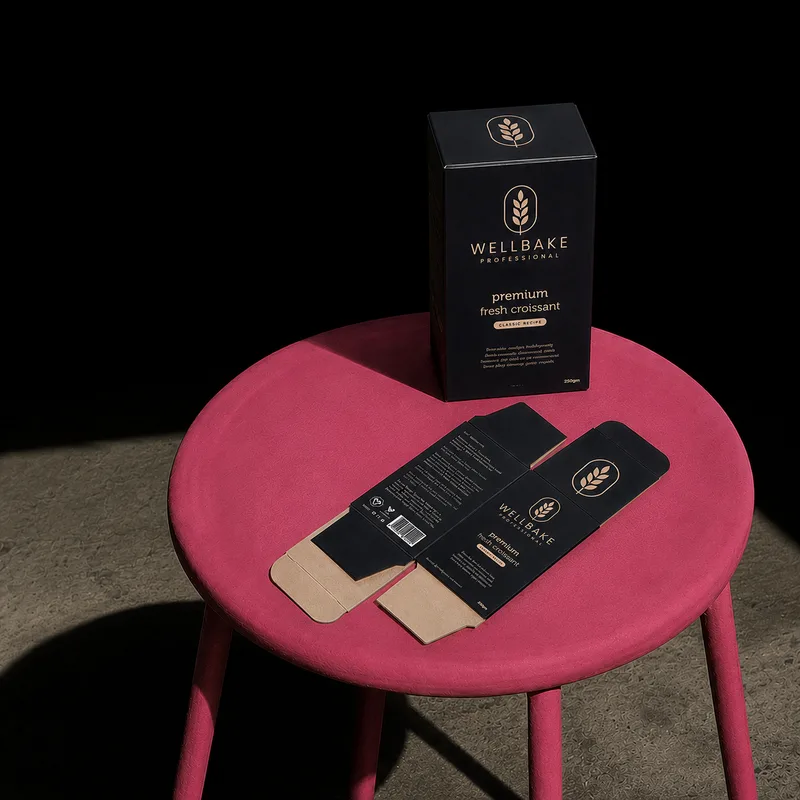
A reverse tuck box, or reverse tuck end (RTE) carton, is a paperboard folding carton with a glued side seam and a tuck flap at each end, where the top tuck hinges from one panel and the bottom tuck hinges from the opposite panel. The carton ships flat, is squared up by hand, and closes at both ends by tucking the flaps in, with no glue at the ends.
How the Opposite Tucks Work
The format works through three features on one blank.
01
Glued Side Seam
A glue flap joins the last panel to the first during production, so the carton arrives as a flat, pre-glued tube that opens into a rectangle.
02
Opposite-Hinged Tuck Flaps
The top tuck folds from one panel and the bottom tuck from the panel opposite. Each tongue slides inside the facing panel to close the end.
03
Dust Flaps
Smaller flaps on the side panels fold in under each tuck, closing the corners and supporting the tuck as it seats.
Anatomy of a Reverse Tuck Box
01
Front and Back Panels
Main print surfaces.
02
Side Panels
Carry the dust flaps.
03
Top Tuck Flap
Hinges from one main panel.
04
Bottom Tuck Flap
Hinges from the opposite main panel.
05
Glue Flap
Forms the side seam in production.
Because the tucks hinge from opposite panels, the top flap and bottom flap print the right way up only if artwork is oriented per end on the dieline. Keep small text off score lines and tuck tongues.
Reverse Tuck vs Straight Tuck at a Glance
| Feature | Reverse Tuck | Straight Tuck End |
|---|---|---|
| Where tucks hinge | Opposite panels | Same panel |
| Blank layout | Can fit efficiently for many proportions | Set per dieline |
| Front panel | One end's tuck opens toward the front | Both ends open toward the same side |
| Typical use | Everyday retail cartons | Cartons where a consistent front presentation matters |
Application guide
When Is a Reverse Tuck Box the Right Choice?
A reverse tuck box suits lightweight and medium-duty retail products that need a printed, re-openable carton without a special bottom, such as cosmetics, soap and personal care, supplements, small accessories and general retail goods. It is a common starting point for everyday printed retail cartons.
01
Efficient
Efficient Blank Layout
Reverse tuck blanks can use sheet area efficiently on many carton dimensions because the top and bottom flaps face opposite directions. This can reduce material use compared with some same-direction layouts, but final cost depends on the complete size, board and production specification.02
Re-Openable
Re-Openable Ends
Both ends can be opened and re-tucked during normal use; repeated opening performance depends on board and finish.03
Broad
Broad Retail Fit
Without a specialized bottom, the format works across many product types and sizes.04
Alternative
When Another Format May Fit Better
If both ends should open toward the same side for a consistent front, choose the Straight Tuck End Box. For a locked bottom, see the Auto Lock Box or the Snap Lock Box. If the carton should remain closed until opened, the Seal End Box closes with peel-and-seal ends.
Reverse Tuck Box Specifications
Custom reverse tuck boxes are specified around carton dimensions, board grade and caliper, tuck depth, dust flaps, print coverage and finishes, with each carton cut from a custom dieline sized to the product loaded through its end.
| Specification | Available Configuration |
|---|---|
| Product Type | Folding carton with opposite-direction tuck closures |
| Category | Tuck Boxes |
| Dimensions | Custom inside L × W × D, built around the product and any insert |
| Core Construction | Glued side seam, top and bottom tuck flaps hinged from opposite panels, dust flaps |
| Board | White SBS, kraft or recycled paperboard; corrugated board; metallic, holographic, pearlescent or textured cardstock |
| Board Caliper | Paperboard from about 14 pt to 28 pt, or E-, F- or B-flute corrugated; matched to the product |
| Inserts | Paperboard, foam/EVA, molded pulp or thermoformed PET/PVC |
| Add-ons | Die-cut window (with or without film), hang tab, tongue lock, tear strip |
| Print Coverage | Exterior only, exterior + interior, or full inside and outside |
| Print Methods | Offset, digital, UV or screen printing; CMYK and Pantone spot colors |
| Coatings and Finishes | Matte, gloss or soft-touch lamination, aqueous or grease-resistant coating, foil stamping, emboss/deboss, Spot UV and raised 3D UV |
| Starting Price | From $0.85 / unit; final price depends on size, board, print, finishes and quantity |
| Minimum Order | 500 units |
| Standard Production | 7 days from approved proof |
| Rush Production | Available on request |
| Shipping | Ships flat, USA and worldwide |
How Reverse Tuck Compares to Other Tuck Box Structures
All five are paperboard folding cartons that ship flat; they differ at the ends.
| Attribute | Reverse Tuck | Straight Tuck End | Auto Lock | Snap Lock | Seal End |
|---|---|---|---|---|---|
| Top | Tuck | Tuck | Tuck | Tuck | Peel-and-seal |
| Bottom | Tuck, opposite side | Tuck, same side | Pre-glued auto bottom | Hand-locked flaps | Peel-and-seal |
| Bottom setup | Tuck in | Tuck in | Opens into place | Fold in sequence | Peel and press |
| Re-openable | Both ends | Both ends | Top only | Top only | No |
| Best fit | Everyday retail cartons | Consistent front presentation | Fewer bottom setup steps | Hand-locked base, no pre-glue | Closed-until-opened products |
What Size Reverse Tuck Box Do You Need?
Folding cartons are sized by inside dimensions, written length × width × depth. Length and width are the opening at the tuck end, the side the product goes in through, and depth is the distance between the two ends. Measure the product or its insert, add clearance, and the dieline adds board thickness.
How Product Size Becomes Carton Size
The figures below are planning references, not fixed manufacturing rules; final allowances depend on product shape, insert and board.
| Step | Typical Allowance |
|---|---|
| Product to inside length and width (the opening) | Add about 1–2 mm (1/16 in) so the product slides in |
| Product to inside depth | Add about 2–3 mm so both tucks seat without pressing the product |
| With an insert | Size to the insert's outer dimensions, not the product |
| Inside to outside | Each dimension grows by about two board thicknesses |
Paperboard Caliper Reference
| Board | Typical Thickness | Typically Suited To |
|---|---|---|
| About 14–16 pt | About 0.36–0.41 mm | Light items: cards, small cosmetics, sachets |
| About 18–20 pt | About 0.46–0.51 mm | Most retail cartons: skincare, soap, supplements |
| About 22–24 pt | About 0.56–0.61 mm | Larger cartons and heavier contents |
| About 26–28 pt | About 0.66–0.71 mm | Large cartons and multi-unit packs |
| E- or F-flute corrugated | About 0.8–1.6 mm | Heavier products or extra edge strength |
| B-flute corrugated | About 3 mm | Large or multi-unit cartons |
Important: Caliper and allowances are reference values. Board is confirmed against the product weight and size, and no fixed weight capacity is stated for a tuck carton without testing the finished pack.
If you are unsure, share the product dimensions and weight with the quote request, and the carton is sized around them.
Does Tuck Depth Matter?
Yes. The tuck tongue needs enough length to hold inside the panel, which depends on carton width and board. Too short and the end can spring open; too long and it is hard to insert. Tuck depth is set on the dieline and checked on a sample.