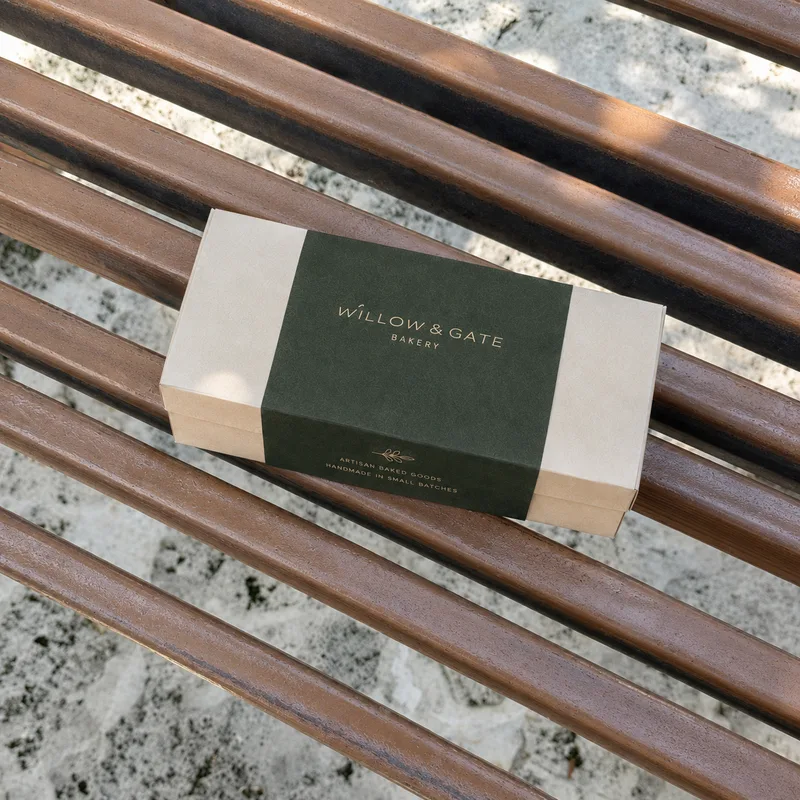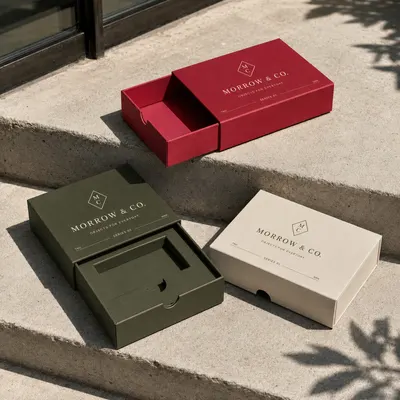
Overview & Specifications
What Is a Slipcase Box?
A slipcase box is an outer case with one open end that surrounds a finished box, book, set or presentation pack. The inner item slides in through the open end and is held by a measured clearance. Unlike a thin box sleeve, which is open at both ends, a slipcase covers every side except one and can be built as a substantial rigid case.
How a Slipcase Box Works
The format works through three construction details.
01
Closed on All Sides but One
The case covers the top, bottom, both sides and the back, leaving one end open for the inner item.
02
Sized to the Inner Package
Inside dimensions follow the finished outside size of the inner box or set, with clearance balanced for smooth sliding and secure seating.
03
Board Chosen for the Role
Paperboard suits a decorative case, while corrugated or rigid board adds handling support around the set.
Anatomy of a Slipcase Box
01
Front and Back Panels
Main printed faces of the case.
02
Spine and Sides
Closed edges around the inner item.
03
Open End
Where the inner item slides in and out.
04
Finger Notch
Optional cut-out to grip the inner item.
05
Interior Surface
Can carry print or a contrasting finish.
The case and the inner pack are seen together and then apart, so artwork on both is planned as one two-stage presentation.
Slipcase vs Box Sleeve vs Drawer Box at a Glance
| Feature | Slipcase Box | Box Sleeve | Drawer Box |
|---|---|---|---|
| Ends | One open end | Both ends open | Sleeve open at one or both ends |
| Build | Case, can be rigid | Thin four-panel tube | Structural sleeve plus tray |
| Inner item | Existing box, book or set | Existing box | A dedicated tray, part of the box |
| Typical role | Two-stage reveal and added support | New exterior over a box | Complete sliding box |
Application guide
When Is a Slipcase Box the Right Choice?
A slipcase box suits sets and collections that deserve a second layer: rigid-box gift sets, books, media and printed collections, gift and presentation kits, and limited-edition packaging where the case is part of the reveal.
01
Layered
Layered Presentation
The outer case creates a first stage before the inner package is opened.02
Surrounding
Surrounding Surface Coverage
The case covers the inner item on all sides but one and gives a large printed surface; protective performance still depends on material and construction.03
Designed
Designed Around the Inner Pack
Clearance is set so the inner item slides without excessive looseness or binding.04
Alternative
When Another Format May Fit Better
For a lighter wrap open at both ends, a Box Sleeve adds a new exterior over a box. If the inner tray should be part of the package itself, see the Custom Drawer Box. For a narrow band only, use a Custom Belly Band.
Slipcase Box Specifications
Custom slipcase boxes are specified around the inner package's finished dimensions, sliding clearance, case depth and coverage, board type and thickness, finger notch, print coverage and finishes, with the case set on a custom dieline for each inner pack.
| Specification | Available Configuration |
|---|---|
| Product Type | Separate open-end outer case |
| Category | Custom Sleeves |
| Dimensions | Custom, sized to the finished outside dimensions of the inner package |
| Core Construction | Case closed on all sides but one open end, per approved dieline |
| Board | White SBS, kraft or recycled paperboard; corrugated board; rigid greyboard wrapped in printed paper; metallic, holographic, pearlescent or textured cardstock |
| Board Range | Paperboard from about 18 pt to 28 pt, E-, F- or B-flute corrugated, or rigid board about 1.5–3 mm |
| Opening | Sliding removal through the open end; optional finger notch |
| Inserts | Paperboard or thermoformed PET/PVC inserts where items are cased loose |
| Print Coverage | Exterior only, or exterior and interior |
| Print Methods | Offset, digital, UV or screen printing; CMYK and Pantone spot colors |
| Coatings and Finishes | Matte, gloss or soft-touch lamination, aqueous coating, foil stamping, emboss/deboss, Spot UV and raised 3D UV |
| Protection | Additional surrounding case, with performance dependent on material and product use |
| Starting Price | From $0.45 / unit; final price depends on size, board, print, finishes and quantity |
| Minimum Order | 500 units |
| Standard Production | 7 days from approved proof |
| Rush Production | Available on request |
| Shipping | Ships flat or set up depending on board, USA and worldwide |
How Slipcase Box Compares to Other Sleeve Structures
| Attribute | Slipcase Box | Box Sleeve | Belly Band | Cup Sleeve |
|---|---|---|---|---|
| Wraps | An inner box, book or set | A finished box | Part of a box, product or group | A beverage cup |
| Coverage | All sides but one open end | Four sides, ends open | Narrow band | Grip zone of the cup |
| Build | Case, paperboard to rigid | Thin tube | Flat band | Ring fitted to the cup |
| Board range | Paperboard, corrugated or rigid board | Paperboard or E/F-flute | Paper or light paperboard | Paperboard, kraft or corrugated |
| Best fit | Two-stage reveal around a set | New exterior over a box | Product stays visible | Grip and branding on cups |
What Size Slipcase Box Do You Need?
Quote by the inner package's finished outside length × width × depth, measured over any wrap, ribbon or lid lip. The case's inside size adds a sliding clearance to those numbers, and the case depth sets how much of the inner item shows at the open end.
There is no fixed size list: any practical size is built to order, across the full board range below.
How Inner Package Size Becomes Case Size
The figures below are planning references, not fixed manufacturing rules; final allowances depend on the inner finish, board and how firm the fit should feel.
| Step | Typical Allowance |
|---|---|
| Inner width and height to case inside | Add about 1–2 mm (1/16 in) for a sliding fit |
| Case depth | Full inner depth, or shorter to leave the end showing |
| Rigid inner box | Measure over the wrap and any lid lip |
| Inside to outside | Each dimension grows by about two board thicknesses |
Board Reference
| Board | Typical Thickness | Typically Suited To |
|---|---|---|
| About 18–24 pt paperboard | About 0.46–0.61 mm | Decorative cases around boxes and books |
| About 26–28 pt paperboard | About 0.66–0.71 mm | Larger sets and frequent handling |
| E-, F- or B-flute corrugated | About 0.8–3 mm | Heavier sets and added edge support |
| Rigid board, wrapped | About 1.5–3 mm | Gift and collector sets |
Important: These are reference figures. Fit depends on the actual inner package, so the case is sized from a sample or confirmed measurements and checked on a pre-production sample.
If you are unsure, send a sample of the inner package or its finished dimensions with the quote request, and the case is sized around it.
Decorative Case or Support Case?
Decide what the slipcase should do before the board is chosen. A paperboard case adds presentation, while corrugated or rigid board also adds handling support around the inner set.