Overview & Specifications
What Is a Belly Band?
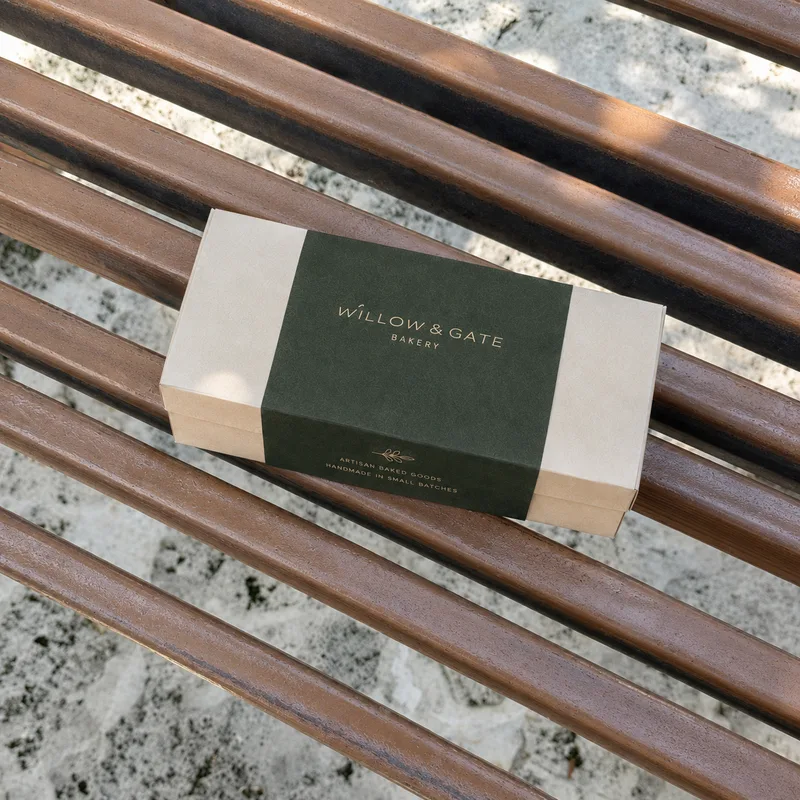
A belly band in packaging is a narrow strip of printed paper or paperboard that circles part of a box, product or bundle and closes on itself. It covers only a band across the package, so the box artwork, product color or texture stays visible above and below it. It is a branding and grouping layer, not the main protective package.
How a Belly Band Works
The format works through three details.
01
Narrow Printed Band
The band is printed flat at the chosen width, then wrapped around the package at the chosen position.
02
Sized to the Finished Circumference
Its length follows the finished circumference of the box, product or grouped items, plus the overlap needed to close it.
03
Overlap, Adhesive or Lock
The ends close with an overlap, an adhesive point or a die-cut locking tab, set on the dieline for the application.
Anatomy of a Belly Band
01
Front Face
Main branding area.
02
Back and Side Faces
Variant, barcode or short copy.
03
Overlap Area
Where the band closes on itself.
04
Closure
Adhesive point or locking tab, per dieline.
The printable area is smaller than a full sleeve, so the logo, product name and variant come first, with the overlap kept clear of key text.
Belly Band vs Box Sleeve at a Glance
| Feature | Belly Band | Box Sleeve |
|---|---|---|
| Coverage | A band around part of the pack | All four sides of the box |
| Package visibility | Most of the pack stays visible | Ends only |
| Material | Paper or light paperboard | Paperboard or E/F-flute |
| Typical role | Name, SKU, offer, grouping | Full new exterior |
Application guide
When Is a Belly Band the Right Choice?
A belly band suits packaging where the box or product should stay visible and only a name, variant, offer or seal-style band is needed: gift boxes and stationery sets, soap and personal care, folded garments and textiles, and retail products whose own packaging carries the look.
01
Minimal
Minimal Material Coverage
The band adds a branded component with less material than a full sleeve, while preserving most of the surface underneath.02
Keep
Keep the Product Visible
Where the primary package, product texture or color sells the item, a belly band adds information without hiding it.03
Flexible
Flexible SKU Identification
Different bands can mark flavors, scents or sizes that share the same box or wrap.04
Alternative
When Another Format May Fit Better
If the whole box needs a new exterior, a Box Sleeve wraps all four sides. For a substantial case around a set, see the Slipcase Box. For beverage cups, use a Cup Sleeve.
Custom Belly Band Specifications
Custom belly bands are specified around band width and position, finished circumference, overlap and closure method, material, print hierarchy and finishes, with the band and closure set on a custom dieline for each package.
| Specification | Available Configuration |
|---|---|
| Product Type | Partial wraparound paper or paperboard band |
| Category | Custom Sleeves |
| Dimensions | Custom band width and length, sized to the finished circumference |
| Core Construction | Single printed band closed by overlap, adhesive or locking tab per approved dieline |
| Coverage | Partial; package ends and other areas stay exposed |
| Material | Paper, white SBS, kraft or recycled paperboard; metallic, holographic, pearlescent or textured cardstock |
| Material Range | Text-weight paper up to about 18 pt paperboard; matched to the band width and closure |
| Print Coverage | Exterior only, or exterior and interior |
| Print Methods | Offset, digital, UV or screen printing; CMYK and Pantone spot colors |
| Coatings and Finishes | Matte, gloss or soft-touch lamination, aqueous coating, foil stamping, emboss/deboss, Spot UV and raised 3D UV |
| Structural Role | Branding and grouping component, not primary protective packaging |
| Starting Price | From $0.45 / unit; final price depends on size, material, print, finishes and quantity |
| Minimum Order | 500 units |
| Standard Production | 7 days from approved proof |
| Rush Production | Available on request |
| Shipping | Ships flat, USA and worldwide |
How Belly Band Compares to Other Sleeve Structures
| Attribute | Belly Band | Box Sleeve | Cup Sleeve | Slipcase Box |
|---|---|---|---|---|
| Wraps | Part of a box, product or group | A finished box | A beverage cup | An inner box, book or set |
| Coverage | Narrow band | Four sides, ends open | Grip zone of the cup | All sides but one open end |
| Closure | Overlap, adhesive or lock | Seam, slides on | Seam, slides on | Built case, slides in |
| Package visibility | Most of the pack | Ends only | Cup above and below | Open end only |
| Best fit | Minimal branding, product visible | New exterior over a box | Grip and branding on cups | Two-stage reveal around a set |
What Size Belly Band Do You Need?
Quote by the band width you want and the finished circumference where the band sits, or the package's outside length, width and height plus the band position. The band length is the circumference plus the overlap or locking tab, set on the dieline.
There is no fixed size list: any practical size is built to order, across the full material range below.
How Package Size Becomes Band Size
The figures below are planning references, not fixed manufacturing rules; final allowances depend on the material, closure and how snug the band should sit.
| Step | Typical Allowance |
|---|---|
| Circumference | Measure around the package where the band sits |
| Band length | Circumference plus the overlap or locking tab |
| Snug fit | Add about 1 mm per side so the band slides into place |
| Grouped items | Measure the bundle as packed, not each item |
| Soft or compressible items | Measure the packed form, as folded or bundled |
Material Reference
| Material | Typical Thickness | Typically Suited To |
|---|---|---|
| Text-weight paper | About 0.1–0.15 mm | Light bands around soft goods and textiles |
| Cover-weight paper | About 0.2–0.3 mm | Gift boxes, stationery and soap |
| About 14–18 pt paperboard | About 0.36–0.46 mm | Wider bands and bands that hold items together |
Important: These are reference figures. Band material, width and closure work together, so the band is confirmed on a sample with the actual package.
If you are unsure, send the package or its dimensions with the quote request, and the band is sized around it.
Where Should the Band Sit?
Position the band where it frames the product name or offer without covering what the customer should see. A centered band reads as a seal, while an offset band leaves the main artwork open.