Overview & Specifications
What Are Child-Resistant Mylar Bags?
Child-resistant Mylar bags are barrier pouches with a closure that needs a deliberate, coordinated action to open. The child-resistant function comes from the zipper and the finished package working together, not from the Mylar film itself. They suit regulated or access-sensitive products where controlled access is part of the packaging requirement.
This is a dedicated variant within the Mylar Bags line. The pouch format, film structure and print setup are configured around each product, and the controlled-access closure is what separates this SKU from a standard Mylar bag.
What it has to do
What Child-Resistant Packaging Has to Do
Child-resistant packaging has to balance two jobs: slow down young children and stay usable for adults. In a Mylar pouch, the closure, film, seals and print all contribute. Each need below is matched to how this variant meets it.
01
Resist
Resist Opening by Young Children
The zipper requires coordinated opening steps at a designated point, so a simple pull-apart motion does not open it. This adds a deliberate access action beyond a standard pouch zipper.02
Stay
Stay Practical for Adults to Open and Reclose
The opening method is designed to remain manageable for adults when the pouch is opened and resecured correctly. Printed opening instructions help adults use the closure the way it was designed.03
Maintain
Maintain Controlled Access After Reclosing
After opening, the zipper can be closed again, so controlled access remains part of the package through repeated handling. Pressing the zipper fully closed along its length is part of correct use.04
Show
Show Evidence of Initial Opening
An optional heat seal above the zipper shows visibly whether the pouch has been opened. It provides tamper evidence only; the child-resistant function still depends on the zipper and finished package.05
Carry
Carry Warnings and Opening Instructions
Regulated products often need warning statements, directions, lot or date codes and barcodes. The printable panels give space for branding alongside that required information.06
Protect
Protect the Packaged Product
The film structure is selected around the product. Metallized and interior aluminum foil laminates add a higher barrier against moisture, oxygen and light, and opaque films keep contents out of view where that is required.
How the Child-Resistant Zipper Works
The child-resistant zipper resists simple pull-apart opening. Access requires a coordinated action at the designated opening point, after which the zipper opens and can be reclosed between uses. The closure, film, seals and finished pouch work together as one package system.
01
Designated Opening Point
The opening action is located at a defined point on the zipper rather than anywhere along the mouth of the pouch.
02
Coordinated Opening Action
The closure needs more than a single pull to release, which is what makes it harder for young children to open.
03
Reclosable Between Uses
The zipper recloses after each use, returning the pouch to its controlled-access state when it is pressed fully closed.
04
One Package System
Seal strength, film stiffness, zipper placement and pouch size all affect how the closure performs, so they are specified together instead of separately.
How Is Child-Resistant Packaging Tested?
In practice, child resistance is evaluated on the finished package configuration, so changing the closure, size, film or construction can affect which test documentation applies.
In the U.S., child-resistant packaging is tested under 16 CFR 1700.20, the federal procedure for special packaging under the Poison Prevention Packaging Act. Panels of children aged 42 to 51 months and adults aged 50 to 70 try to open the finished package. Testing applies to the exact package, not to the film or zipper alone.
Child panel: groups of 50 children, up to 200 in total, get 5 minutes to open the package, see a demonstration, then get another 5 minutes. Under 16 CFR 1700.15, child-resistant effectiveness must be at least 85% without a demonstration and at least 80% after it.
Adult panel: 100 adults aged 50 to 70 must be able to open and, where applicable, properly resecure the package. Senior adult use effectiveness must be at least 90%.
Reclosable packages: the package must keep meeting these effectiveness levels for the number of openings and closings customary for its size and contents.
ASTM D3475-20: this standard classifies types of child-resistant packages by the actions needed to open them. A classification listing does not show that a package passed testing.
Child-resistant closures and pouch constructions are available with supporting test documentation for qualifying configurations. The exact documentation is confirmed during specification against the selected closure, format, size and film, because a report covers the package that was tested.
Who is responsible: CPSC does not approve or certify packaging. The company that puts the regulated product into the package is responsible for meeting the requirements, and it may rely on the package manufacturer's test data for certification when that data represents the package actually used.
Which Pouch Format Fits Your Product?
Stand Up, Flat Bottom and 3 Side Seal pouches can all carry the child-resistant zipper. Choose the format by how the product is filled, displayed and handled after opening, and how much panel space the warnings and directions need.
| Format | Best for in a CR project | Decision factor |
|---|---|---|
| Stand Up Pouch | Retail products that need to stand on a shelf and be reopened | Suits repeated consumer access with upright display; the gusset adds volume for multi-serving fills |
| Flat Bottom Bag | Larger packs that need a stable base and more print panels | Five printable panels create dedicated space for warnings, opening instructions and branding |
| 3 Side Seal Pouch | Smaller, flatter fills and single packs | Flat construction suits small or compact fills where a bottom gusset is unnecessary |
Child-Resistant vs Standard Mylar Bags vs Tamper-Evident Seals
These three are often confused. A child-resistant closure controls access, a standard closure only reseals, and a tamper-evident seal only shows whether the pouch was opened. One does not provide the others, so many regulated products combine a CR zipper with a heat seal.
| Feature | Child-Resistant Mylar Bag | Standard Mylar Bag | Tamper-Evident Heat Seal |
|---|---|---|---|
| Purpose | Make opening harder for young children | Hold and protect the product | Show whether the pouch was opened |
| Opening | Coordinated action at a designated point | Simple pull-apart or tear | Tear above the zipper |
| Reclosing | Recloses to controlled access | Depends on the closure | Does not reclose; it is removed |
| Child access | Designed to resist young children | Not designed to resist | Not designed to resist |
| Evidence of opening | Only with an added heat seal | Only with an added heat seal | Yes |
| Basis of any claim | Finished-package testing | Not applicable | Visible seal design |
Child-Resistant Mylar Bag Specifications
Child-resistant Mylar bags are configured across pouch format, dimensions, film structure, printing and finishes. Review the technical specifications below to plan procurement, artwork and production.
| Specification | Available Configuration |
|---|---|
| Product Type | Child-Resistant Mylar Bags |
| Category | Mylar Bags |
| Closure | Child-Resistant Zipper |
| Compatible Bag Formats | Stand Up Pouch, Flat Bottom Bag, 3 Side Seal Pouch |
| Custom Dimensions | Custom W × H for 3 Side Seal; Custom W × H × Gusset for Stand Up and Flat Bottom |
| Materials | PET Film, Clear PET Film, Metallized PET Film, Holographic PET Film, Kraft Paper Laminate |
| Print Methods | Digital, Flexographic, Rotogravure |
| Print Colors | Full-color CMYK and Pantone spot colors |
| Coating / Lamination | Gloss, Matte, Soft-Touch, Interior Aluminum Foil |
| Finishes | Foil Stamping, Spot UV, Raised 3D UV, Clear Window |
| Tamper Evidence | Optional heat seal above the zipper |
| Testing Documentation | 16 CFR 1700.20 test documentation available for qualifying configurations; confirmed during specification |
| Starting Price | From $0.65 / unit; final price depends on size, format, film, printing, finishes and quantity |
| Minimum Order | 500 units |
| Standard Production | 7 days from approved proof |
| Rush Production | Available on request |
| Shipping | USA and worldwide |
| Brand | Packaging Dock |
| SKU | PD-CHILDRESISTANTMYLARBAGS |
What Size Child-Resistant Mylar Bag Do I Need?
The right size depends on the product volume, the pouch format and the space the zipper and seals take up. Stand Up and Flat Bottom pouches are sized by width, height and gusset; 3 Side Seal pouches by width and height. Allow headspace above the fill so the zipper can close fully.
Width, height and gusset: Stand Up and Flat Bottom formats add gusset depth for volume and display. 3 Side Seal pouches use a flatter width-and-height profile for smaller fills.
Zipper and seal allowance: the zipper sits below the top seal, and side and bottom seals take up part of each panel. The usable fill area is smaller than the outer dimensions.
Headspace: the product must sit below the zipper with enough room for the closure to engage along its full length. An overfilled pouch cannot reclose to its controlled-access state.
Filling method: hand filling, filling through the top before sealing and machine filling each need different clearances, which are set on the dieline.
Warning and instruction space: if the product needs long warning statements or directions, the panel size may decide the pouch size as much as the fill does.
Common Child-Resistant Bag Sizes by Fill Weight
Across the market, child-resistant bags for dry products such as flower, gummies or loose botanicals are commonly sized in these ranges. They are starting points for a quote, not fixed sizes.
| Fill weight | Ounces | Market reference size (inches) | Typical format |
|---|---|---|---|
| 1 g | About 1/28 oz | About 3 × 4 to 3.75 × 4 | 3 Side Seal / lay-flat |
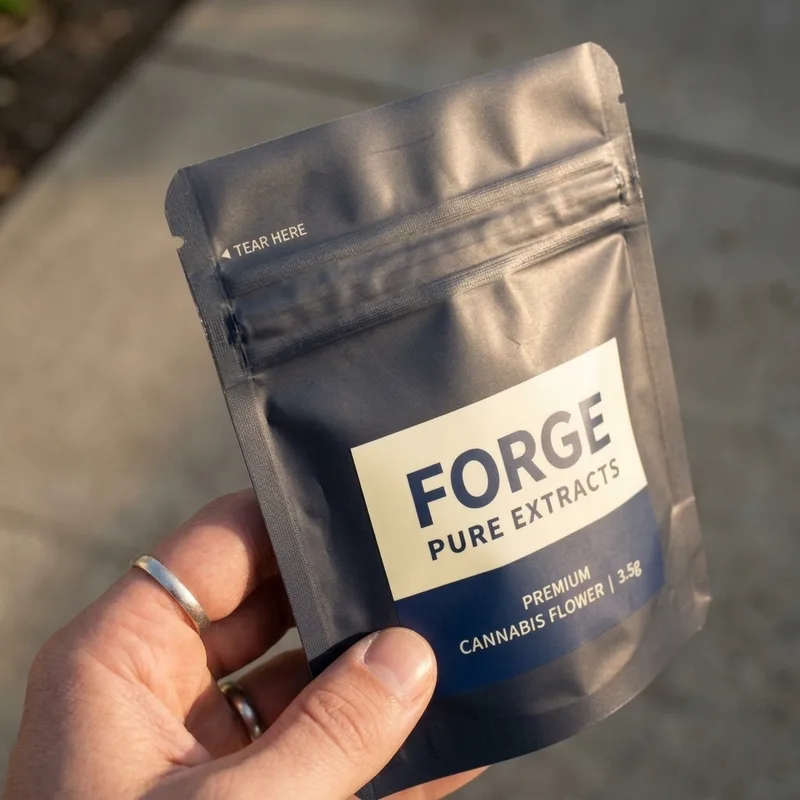
| 3.5 g | 1/8 oz | Flat: about 3.5 × 5; Stand Up: about 3.75 × 6 × 2 | 3 Side Seal or Stand Up |
| 7 g | 1/4 oz | About 4 × 6 to 4 × 7.25 × 2 | Stand Up |
| 14 g | 1/2 oz | About 5 × 8 to 5 × 8 × 2.5 | Stand Up |
| 28 g | 1 oz | About 6 × 9 to 6 × 10 × 2.5 | Stand Up |
Important: These are market reference sizes, not guaranteed capacities. The same weight takes up very different space depending on the product's density, piece size and how it settles, and the zipper and seals reduce the usable area. Dimensions are confirmed around the actual product, fill method and required print area, and a trial fill is recommended before the production dieline is approved.
If you are unsure, share the product and target fill with the quote request and Packaging Dock will recommend a starting size.