Overview & Specifications
What Are Coffee Bags with Valve?
Coffee bags with valve are flexible coffee packages fitted with a one-way degassing valve. Freshly roasted coffee keeps releasing carbon dioxide after roasting; the valve gives that gas a controlled way out to help limit swelling, while limiting outside air coming back in through the valve opening.
The valve manages gas release, while the film structure, seals and residual oxygen determine the wider barrier environment inside the package. For coffee programs that do not need a valve, see Custom Coffee Bags, the broader coffee-packaging page in the Mylar Bags range.
How a One-Way Degassing Valve Works
A one-way degassing valve opens when gas pressure inside the bag reaches its operating range, lets carbon dioxide escape, then closes again to limit outside air entering through the valve. A correctly specified valve allows freshly roasted coffee to be packed while degassing continues, with released gas given a controlled path out of the package.
01
Pressure builds
freshly roasted coffee releases carbon dioxide inside the sealed bag.
02
Valve opens
when internal pressure reaches the valve's opening range, gas passes out through the valve.
03
Valve closes
once pressure drops, the valve closes to limit reverse airflow through its opening.
04
Barrier stays separate
oxygen, moisture, aroma and light protection still depend on the complete laminate and seals, not on the valve.
What it has to do
What Fresh Coffee Needs from Its Packaging
Freshly roasted coffee needs a way to release gas without letting staling air back in, plus a barrier that protects aroma and a closure for daily use. Each need below is matched to how a valve bag meets it.
01
Release
Release CO2 After Roasting
The one-way valve gives gas generated by freshly roasted coffee a controlled path out of the package, helping manage internal pressure when the valve and packing process are correctly matched.02
Limit
Limit Air Coming Back In
The valve closes after venting, limiting reverse airflow through the valve opening. Total oxygen exposure still depends on the film structure, seals, residual oxygen and handling, so the bag is never described as oxygen-free.03
Allow
Allow Earlier Packing After Roasting
A correctly specified valve can reduce the need to leave freshly roasted coffee unsealed solely for degassing before packing. The actual packing schedule still depends on coffee type, roast and process.04
Reclose
Reclose After Opening
The valve and the zipper do different jobs. The valve manages gas before opening; a resealable zipper lets the customer reclose the bag between uses after it is opened.05
Keep
Keep the Barrier Around the Valve
The valve sits in a high-barrier laminate. Metallized or aluminum-foil layers can be used where greater opacity and barrier performance are required.
Which Bag Format Fits Your Valve Coffee?
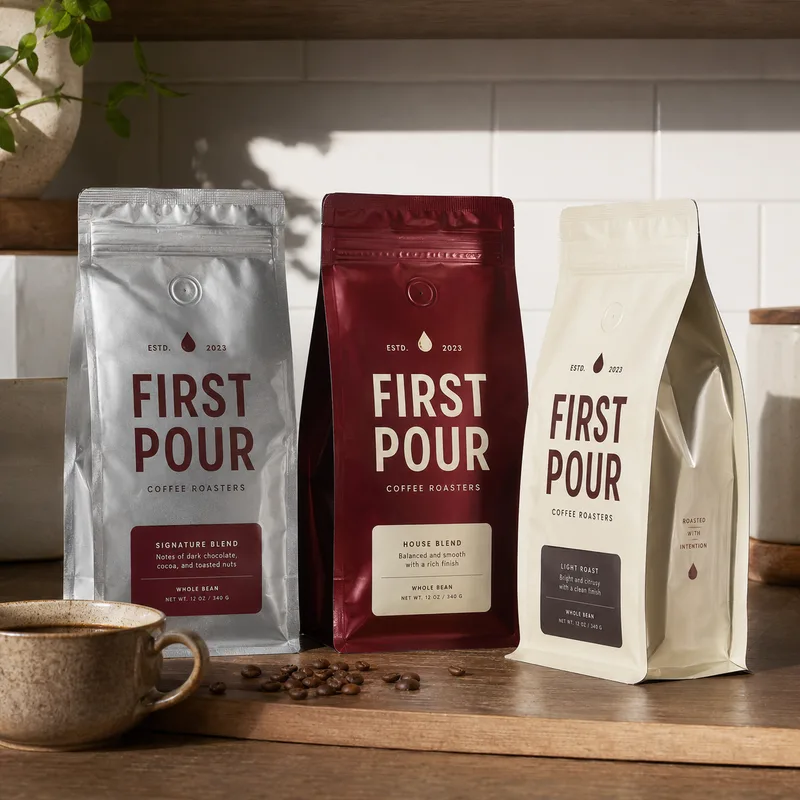
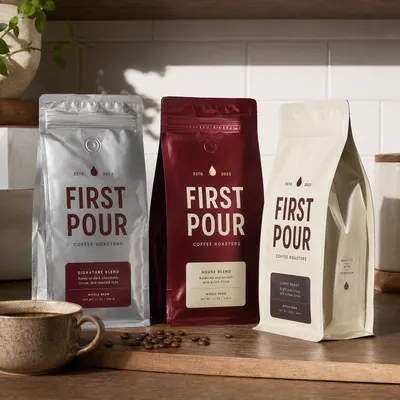
Stand Up, Flat Bottom and Back Seal bags can carry a one-way valve. Choose Stand Up for familiar retail bags up to about 2 lb, Flat Bottom for a structured shelf profile and larger packs, and Back Seal for wholesale and automated filling. Valve placement is set for each format.
| Format | Best for with a valve | Decision factor |
|---|---|---|
| Stand Up Pouch | Retail whole bean and ground coffee | Valve placed above the fill line; pairs with a zipper |
| Flat Bottom Bag | Shelf-led retail and 2 to 5 lb bags | Five panels leave room for the valve, origin and brewing information |
| Back Seal Bag | Wholesale and café supply | Pillow-style bag for form-fill-seal lines; valve position set with the filling process |
Coffee Bags With vs Without a Valve
A valve bag is often used when freshly roasted whole bean or ground coffee is packed while significant degassing is still occurring; the need depends on roast, coffee form, time before packing, fill and headspace. Coffee that has already degassed, instant coffee and dry coffee mixes usually do not need a valve and can use Custom Coffee Bags instead.
| Situation | With valve | Without valve |
|---|---|---|
| Freshly roasted whole bean, packed while degassing | Often used | Bag may swell |
| Ground coffee, packed soon after roasting | Often needed; confirm with the coffee | Depends on degassing time |
| Coffee rested before packing | Optional | Often suitable |
| Instant coffee and dry mixes | Not needed | Suitable |
| What the valve does not do | Make the bag oxygen-free or set a shelf life |
Coffee Bag with Valve Specifications
Coffee bags with valve are developed as a complete coffee-packaging system combining the bag format, film structure, valve, closure and filling process.
| Specification | Available Configuration |
|---|---|
| Product Type | Coffee Bag with One-Way Degassing Valve |
| Category | Mylar Bags |
| Compatible Formats | Stand Up Pouch, Flat Bottom Bag, Back Seal Bag |
| Custom Dimensions | Developed around coffee fill weight, bag format and headspace requirements |
| Materials | PET Film, Clear PET Film, Metallized PET Film, Holographic PET Film, Kraft Paper Laminate |
| Valve | One-way degassing valve, placement and specification confirmed for the coffee and bag format |
| Closure / Features | Ziplock, hook-and-loop zipper, tear notch, hang hole where compatible |
| Print Methods | Digital, Flexographic, Rotogravure |
| Print Coverage | According to selected bag format |
| Print Colors | Full-color CMYK and Pantone spot colors |
| Coating / Lamination | Gloss, Matte, Soft-Touch, Interior Aluminum Foil |
| Finishes | Foil Stamping, Spot UV, Raised 3D UV, Clear Window where appropriate |
| Starting Price | From $1.25 / unit; final price depends on format, size, film, valve, printing and quantity |
| Minimum Order | 500 units, subject to final valve and construction confirmation |
| Standard Production | 7 days from approved proof after valve, structure and finish are confirmed |
| Rush Production | Available on request |
| Shipping | USA and worldwide |
What Size Coffee Bag with Valve Do I Need?
Bag size follows the same coffee fill and format considerations covered on Custom Coffee Bags, but a valve bag also needs enough clear area above the expected fill line for valve placement. Confirm fill weight, headspace and valve position together before the dieline is approved.
For reference sizes from 8 oz to 5 lb in Stand Up and Flat Bottom formats, see the Custom Coffee Bags size guide. A trial fill is recommended before the production dieline is approved.