Overview & Specifications
What Are Custom Coffee Bags?
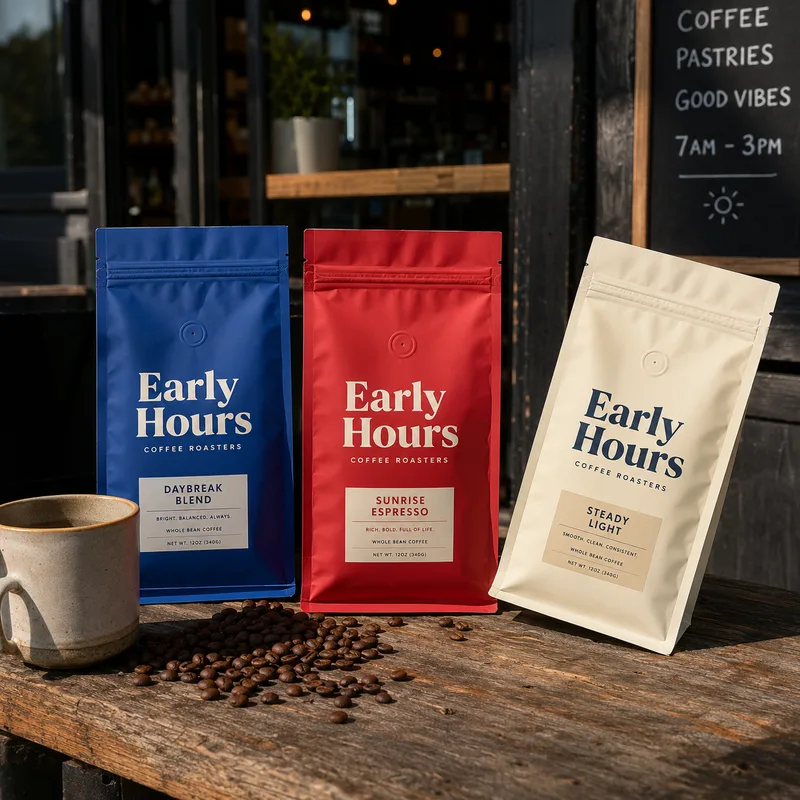
Custom coffee bags are flexible pouches printed with a roaster's own branding and built around a specific coffee. The bag format, dimensions, barrier film, closure, graphics and optional degassing valve are chosen for the coffee form, fill weight, sales channel and packing workflow instead of starting from one fixed bag style.
Custom coffee bags are the broader coffee-packaging platform within the Mylar Bags range. When freshly roasted coffee needs controlled degassing, the Coffee Bags with Valve configuration is used so the valve is developed with the bag.
What it has to do
What Coffee Needs from Its Packaging
Roasted coffee loses quality through oxygen, moisture, light and aroma loss, and fresh roasts also release carbon dioxide. A coffee bag has to manage each of these while carrying the roaster's information. Each need below is matched to how custom coffee bags meet it.
01
Keep
Keep Out Oxygen, Moisture and Light
Oxygen stales roasted coffee, moisture affects grounds and light degrades aroma compounds. The laminate is developed around these requirements using clear, printed, metallized or aluminum-foil constructions according to the protection and presentation required.02
Hold
Hold Aroma After Opening
Most coffee is used over days or weeks. A resealable zipper on compatible Stand Up and Flat Bottom formats lets the customer reclose the bag between uses instead of folding it over.03
Manage
Manage Degassing When Needed
Freshly roasted whole bean or ground coffee may release carbon dioxide after packing. Valve need depends on the coffee and packing process, so detailed valve selection is handled through the Coffee Bags with Valve configuration when required.04
Fit
Fit Standard Retail Weights
Coffee is sold in familiar weights such as 12 oz, 1 lb, 2 lb and 5 lb. Dimensions are developed around the coffee's fill weight, density and headspace so each size fills correctly.05
Carry
Carry Roast, Origin and Brewing Information
Coffee buyers look for roast level, origin, tasting notes, roast date and brewing guidance. The printed panels are laid out so that information is easy to find alongside the brand.06
Build
Build a Multi-SKU Family
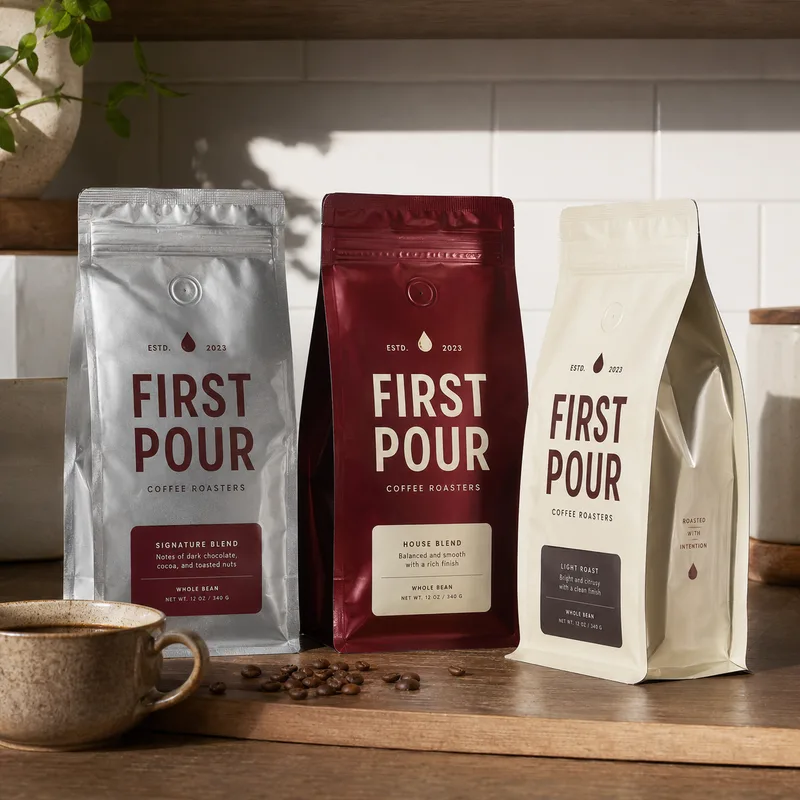
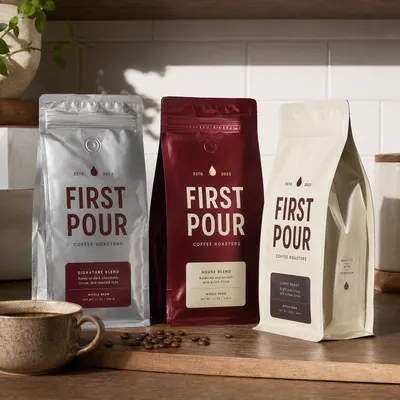
Roasters rarely sell one coffee. Coordinated printing, finishes and panel layouts create a consistent packaging family while differentiating origins, roast levels, flavors, sizes and seasonal releases.
Which Bag Format Fits Your Coffee?
Stand Up, Flat Bottom, 3 Side Seal and Back Seal pouches all suit coffee. Choose by pack size, shelf presentation, panel space and filling process: Stand Up for familiar upright retail, Flat Bottom for a structured five-panel shelf profile, 3 Side Seal for samples and Back Seal for compatible automated filling.
| Format | Best for in a coffee program | Decision factor |
|---|---|---|
| Stand Up Pouch | Retail bags from 8 oz to 2 lb | Familiar upright format with zipper; broad range of fills |
| Flat Bottom Bag | Shelf-led retail and larger bags up to 5 lb | Box-like base and five printable panels for origin and brewing information |
| 3 Side Seal Pouch | Samples, single brews and compact packs | Flat format for small fills where a gusset is unnecessary |
| Back Seal Bag | Wholesale and automated filling | Pillow-style bag suited to form-fill-seal lines |
Stand Up vs Flat Bottom Coffee Bags
Stand up and flat bottom are the two most common retail coffee bags. A stand up pouch is simpler and suits most retail sizes; a flat bottom bag stands squarer on the shelf and gives more printable area, which helps when the bag carries detailed origin and brewing information.
| Feature | Stand Up Coffee Bag | Flat Bottom Coffee Bag |
|---|---|---|
| Base | Bottom gusset opens to stand | Flat rectangular base with side gussets |
| Printable panels | Front and back | Front, back, two sides and base |
| Shelf profile | Upright, tapers toward the top | Box-like and stable |
| Typical coffee sizes | 8 oz to 2 lb | 8 oz to 5 lb |
| Zipper and valve | Compatible | Compatible |
| Best for | Broad retail ranges | Shelf presence and larger packs |
Custom Coffee Bag Specifications
Custom coffee bags are configured around coffee type, bag format, fill weight, barrier needs, closure, valve decision and brand presentation.
| Specification | Available Configuration |
|---|---|
| Product Type | Custom Coffee Bag |
| Category | Mylar Bags |
| Compatible Formats | Stand Up Pouch, Flat Bottom Bag, 3 Side Seal Pouch, Back Seal Bag |
| Custom Dimensions | Developed around coffee fill weight, density and selected bag format |
| Reference Sizes | 8 oz to 5 lb whole bean, with custom sizing |
| Materials | PET Film, Clear PET Film, Metallized PET Film, Holographic PET Film, Kraft Paper Laminate |
| Barrier Configuration | Selected around oxygen, moisture, aroma and light requirements |
| Closure / Features | Ziplock, hook-and-loop zipper, tear notch, hang hole, clear window and optional one-way degassing valve where compatible |
| Print Methods | Digital, Flexographic, Rotogravure |
| Print Coverage | According to selected bag format |
| Print Colors | Full-color CMYK and Pantone spot colors |
| Coating / Lamination | Gloss, Matte, Soft-Touch, Interior Aluminum Foil |
| Finishes | Foil Stamping, Spot UV, Raised 3D UV, Clear Window |
| Starting Price | From $1.25 / unit; final price depends on format, size, film, valve, printing and quantity |
| Minimum Order | 500 units |
| Standard Production | 7 days from approved proof after format, film, finish and functional features are confirmed |
| Rush Production | Available on request |
| Shipping | USA and worldwide |
What Size Coffee Bag Do I Need?
Coffee bag size depends on the coffee's fill weight and density and on the bag format. As a guide, a 12 oz whole bean bag is about 7 × 11 × 3.5 inches as a stand up pouch or 4.9 × 9.1 × 3.1 inches as a flat bottom bag. Ground coffee packs more densely, so the same bag holds slightly more.
| Whole bean fill | Stand Up Pouch (W × H × G) | Flat Bottom Bag (W × H × G) |
|---|---|---|
| 8 oz | 6 × 9.5 × 3.25 in | 5.1 × 7.9 × 2.8 in |
| 12 oz | 7 × 11 × 3.5 in | 4.9 × 9.1 × 3.1 in |
| 1 lb | 7.6 × 11.75 × 4 in | 5.5 × 10.4 × 3.1 in |
| 2 lb | 9.6 × 14 × 3 in | 5.9 × 11.8 × 3.9 in |
| 5 lb | Flat Bottom recommended | 7.1 to 8.7 × 15 to 16 × 4.7 in |
Important: These are reference sizes, not guaranteed capacities. Bean size, roast level, grind, settling, valve position and required headspace all change the final dimensions, so a trial fill is recommended before the production dieline is approved.
If you are unsure, share the coffee, roast and target weight with the quote request and Packaging Dock will recommend a starting size.