Overview & Specifications
What Are Handmade Soap Boxes?
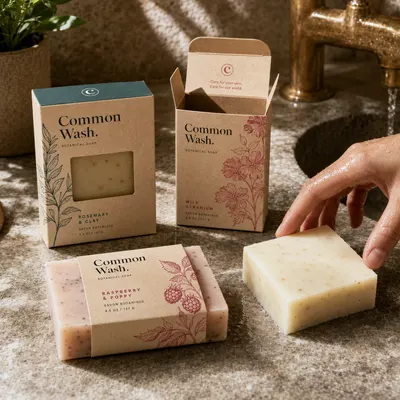
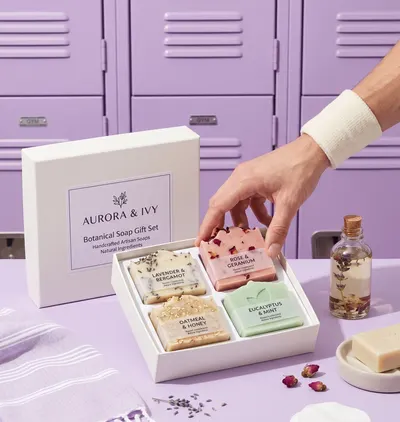
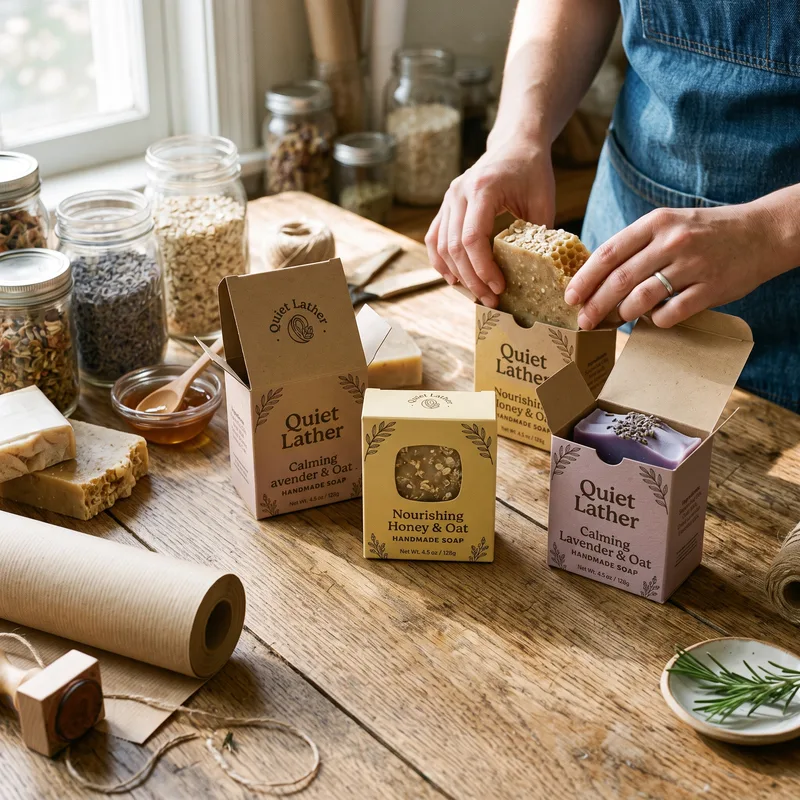
Handmade soap boxes are cartons for soap made in small batches, usually cold-process or melt-and-pour bars cut from a loaf. Because bars are hand-cut and shrink while curing, the box is sized with more clearance than a machine-pressed bar needs.
Packaging Dock lists them in the Tuck Boxes range and under Soap Packaging.
What it has to do
What a Handmade Bar Needs from Its Box
A handmade bar needs room for size variation, a fully cured bar before packing, protection from moisture where the soap attracts it, space for honest label copy and a look that fits a small-batch brand. Each need below is matched to the option that meets it.
01
Room
Room for Size Variation
02
A
A Fully Cured Bar Before Packing
03
Protection
Protection Where the Soap Attracts Moisture
04
Label
Label Copy That Matches the Claims
05
A
A Look That Fits a Small Batch
Handmade vs Uniform-Size Soap Boxes
A handmade soap box is sized for variation; a uniform-size box is sized to one repeatable bar size. The table shows what changes.
| Attribute | Handmade Bar Box | Uniform-Size Bar Box |
|---|---|---|
| Bar size | Varies by cut and cure | Exact and repeatable |
| Inside size | Set from the largest typical bar | Set to the bar |
| Wrap | Often none (cold process) or wrap (glycerin) | By formula |
| Run pattern | Several scents in short runs | Larger runs per SKU |
| Common look | Window, kraft or simple print | Full-color branding |
Handmade Soap Box Specifications
Handmade soap boxes are specified around cured bar size, variation allowance and copy. Review the specifications below to plan the carton.
| Specification | Available Configuration |
|---|---|
| Product Type | Folding carton for handmade and artisan soap bars |
| Category | Tuck Boxes |
| Structure | Straight Tuck End or Reverse Tuck, chosen by bar shape and packing method |
| Dimensions | Customized around the largest typical cured bar and any wrap |
| Board | Paperboard 14–18 pt, 20–24 pt or 26–28 pt; E/F-flute or B-flute corrugated |
| Window / Cutout | Optional, to show the bar or let scent through |
| Interior | Insert or wrap to take up size variation where needed |
| Inserts | Paperboard, foam/EVA or molded pulp |
| Print Coverage | Exterior only, exterior + interior, or full inside and outside |
| Print / Finishes | CMYK and Pantone spot color; matte, gloss or soft-touch lamination, foil stamping, emboss/deboss and Spot UV, according to the board |
| Starting Price | From $1.25 / unit; final price depends on size, board, print, finishes and quantity |
| Minimum Order | 500 units |
| Standard Production | 7 days from approved proof |
| Rush Production | Available on request |
| Shipping | Ships flat, USA and worldwide |
How Do You Size a Handmade Soap Box?
Measure representative finished bars across batches, including the smallest and largest, and size the carton to the largest. A common loaf-cut bar is about 3 3/4 x 2 1/4 x 1 in, but cuts vary. The Straight Tuck End sizing guide lists carton allowances.
| Measurement | What to Record |
|---|---|
| Largest bar | Cured length, width and thickness |
| Smallest bar | To check how much slack the box allows |
| Wrap | Added thickness of any wrap or band |
| Scents | Number of scents sharing one size |
Test the Smallest and Largest Bars
Pack the smallest and largest cured bars. The large one should close without forcing the tucks; the small one should not slide freely.
What to Check Before Bulk Production
Review packed samples with the largest and smallest bars. Record the approved inside size and any insert on the signed-off sample.
| If the sample shows | Review before approval |
|---|---|
| Largest bar forces the tucks | Increase the inside size |
| Smallest bar slides | Add a wrap or insert |
| Glycerin bar beads moisture | Wrap the bar before boxing |
Seven days covers standard production from approved proof once the specification is confirmed; delivery timing is confirmed separately.