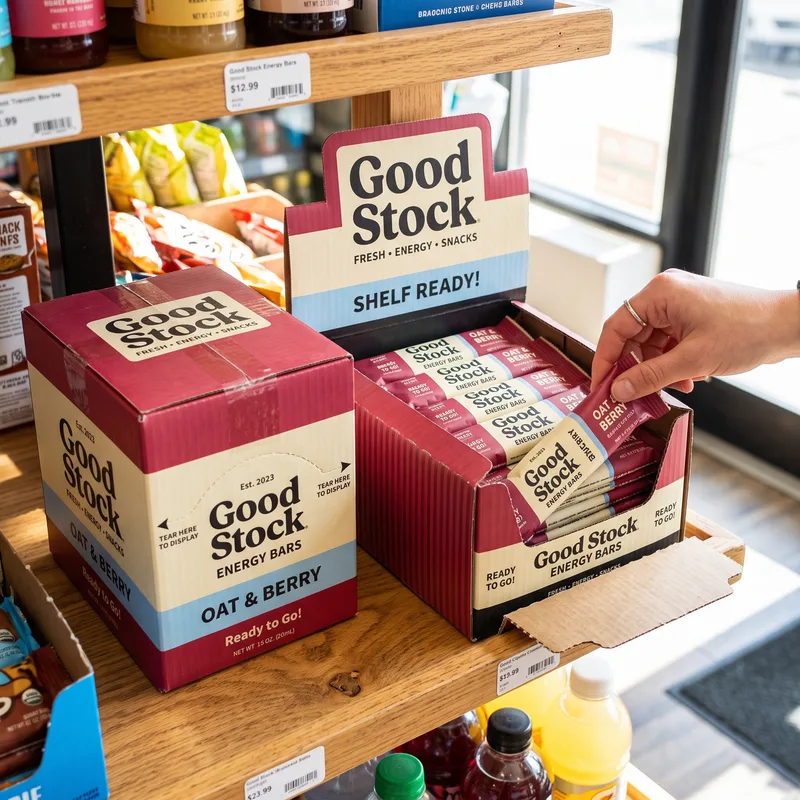
Shelf Ready Packaging
Corrugated cases with a perforated tear-away panel or hood and tray that goes on the shelf.
From $1.25/unit
5 answers →Why staff unpack units one by one, a display sags or a variant needs a new carton, which shelf ready case, display, hang tab box or sleeve suits where your product sits in store, and what barcodes and labels need. Each answer gives the cause first, then the pack that solves it.
Which Retail Display or Box Do You Need?Browse retail packaging →
Each answer below is linked to the product it applies to. Pick a product to see its answers, open its page for sizes and pricing, or compare the full retail packaging range.
Corrugated cases with a perforated tear-away panel or hood and tray that goes on the shelf.
From $1.25/unit
5 answers →
Display trays and boxes for one product on a shelf or table.
From $1.25/unit
9 answers →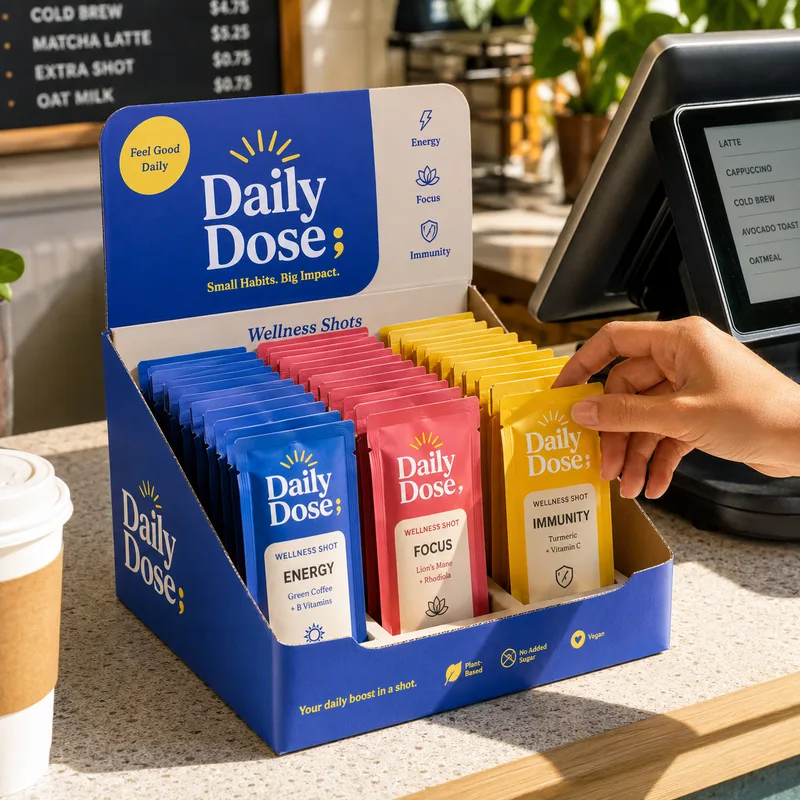
Countertop trays with a header card and front lip, sized to the counter.
From $1.25/unit
1 answers →
Straight Tuck End cartons with an integrated tab and slot or hole.
From $0.68/unit
6 answers →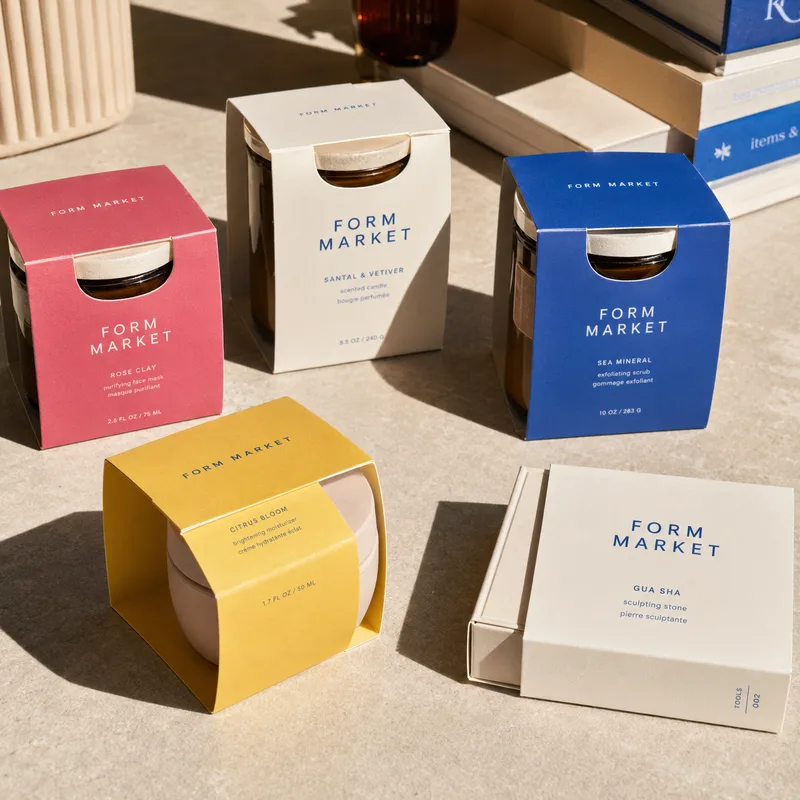


Specialty paper totes with ribbon, rope or twisted handles.
From $1.24/unit
1 answers →Open a problem to see why it happens and how to fix it.
Why it happensA standard shipping case has to be opened and emptied before anything reaches the shelf.
How to fix itUse a shelf ready tray: a perforated panel or hood comes off by hand and the case goes on the shelf as a tray.
Why it happensPerforations balance two jobs: strong enough to survive transit and stacking, weak enough to tear by hand. Set too strong, the panel rips across the print; too weak, it opens in transit.
How to fix itConfirm opening by hand on a sealed, packed sample, with transit checked with the opening features in place.
Why it happensSmall items on a shelf or in a basket have no presence at the counter where the buying decision is made.
How to fix itUse a countertop POS display with a header card that names the product.
Why it happensPaperboard is a single dense sheet; heavy units bend the tray floor and front lip over time, most of all when the display is restocked.
How to fix itMove heavier units to E- or B-flute corrugated and check the display loaded with your product.
Why it happensWhen each SKU has its own printed carton, every new flavor or scent means a new print run.
How to fix itUse one shared box with a retail sleeve per SKU, where the box still suits the product.
Why it happensA carton without a hang feature has nothing for the peg hook to go through.
How to fix itUse a hang tab box, and check the filled weight hangs straight.
Placement decides the pack. Shelf ready cases move units straight onto the shelf. Aisle display boxes group the same product on a shelf or table. Countertop POS displays hold small impulse items at checkout. Hang tab boxes hang on peg hooks.
| Placement | Packaging | Note |
|---|---|---|
| Shelf, case to tray | Shelf Ready Packaging | Perforated panel or hood |
| Aisle, grouped product | Custom Retail Display Boxes | Tear-away top or header display |
| Checkout counter | Point of Sale Packaging | Header card and front lip |
| Peg hooks | Hang Tab Boxes | Integrated tab, from $0.68 |
All others from $1.25 per unit.
A tear-away top opens along perforations and exposes the product fully, with branding on the front and sides. A header display folds the top back into a slot as a sign, adding a branded header above the front and top.
A corrugated case with a perforated tear-away panel, or a hood and tray, that opens by hand and goes on the shelf as a tray. Transit and stacking are verified with the opening features in place, under agreed test conditions. Flute and grade are set by load and stacking.
With a retail sleeve over a shared box, a new variant is a new sleeve if the box still suits. With a printed carton per SKU, every variant is a new carton. Sleeves suit large or changing ranges; cartons suit a fixed line and a one-piece look.
LinksRetail Packaging Sleeves →Custom Sleeves guide →Tuck Boxes guide →
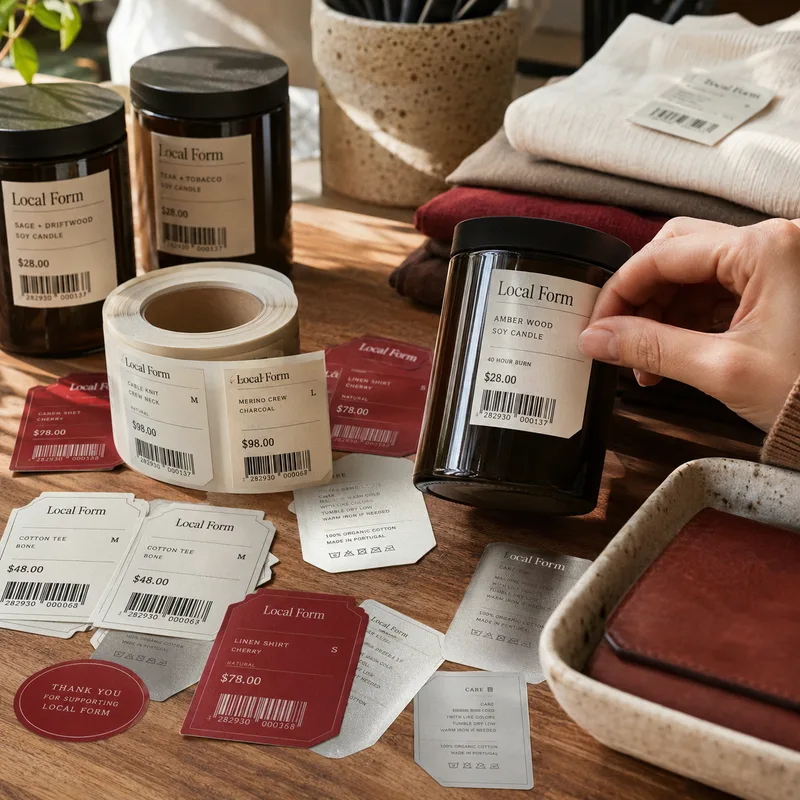
Brand, product, required copy and a barcode, on a stock and adhesive chosen for the pack surface and shelf conditions. Product labels last the life of the product on the shelf, so print and adhesive are chosen for handling; shipping labels only need to last one delivery.
Standard shopping bags use kraft or white paper with twisted or die-cut handles for everyday checkout; boutique bags use specialty, textured or coated paper with ribbon, rope or twisted handles. Totes carry apparel and boxed goods; flat bags carry cards, books and small accessories.
LinksCustom Shopping Bags →Boutique Shopping Bags →Paper Bags guide →
Send the product and unit count, where it sits in store, the retailer's case or display requirements and artwork. Quotes typically come back within 24 hours; orders dispatch 7 days after proof approval, plus shipping time, with rush available, and orders start at 500 units.
Have these six answers ready and your quote starts from the right specification. To compare every product side by side, see the retail packaging range.
Packaging Dock makes custom retail packaging to order from 500 units and ships across the USA and worldwide. These are the questions brands selling in stores ask most. Everything is on the retail packaging page.
No answers for this product in this topic.
Packaging that sells a product in a store: the carton or label the shopper picks up, the display or shelf-ready tray it sits in, and the bag it leaves in. Non-retail packaging only moves goods (shipping cases, mailers) and is built for transit, not the shelf.
Designing the pack to be read on the shelf: brand, product and the key benefit clear on the front at a glance, required copy and barcode on side or back panels, and a pack shape that suits the shelf, peg or counter it will sit on.
Hang tab boxes start from $0.68 per unit; display boxes, POS displays, shelf-ready cases, retail sleeves, product labels and shopping bags start from $1.24. Final price depends on size, board, print and quantity.
500 units, with a standard turnaround of 7 days from proof approval to dispatch, plus shipping time and rush turnaround available on request.
Pick the placement first (shelf, peg, aisle or counter), then design the front for distance: one clear message, strong contrast, the variant color-coded. Logos print on boxes in CMYK or Pantone, with foil, emboss or Spot UV; each order gets a custom dieline, free design support and a proof.
Paperboard or corrugated display trays or boxes that hold several units of one product on a shelf, table or counter, in tear-away top, header, front cut-out or open-tray configurations. Setup is a tear along the perforations or a fold into the header slot.
A tear-away top opens along perforations and exposes the product fully. A header display folds the top back into a slot as a printed sign above the product. A front cut-out shows the product through the front panel. A tear-away perforation is a line of cuts that lets the panel come off cleanly by hand.
Yes: countertop trays with a header card and front lip, sized to the counter space the store allows. Packaging Dock supplies the empty displays; your team or co-packer fills them. Floor displays aren’t a Packaging Dock product.
As many as the layout, board and shelf or counter space allow, confirmed on a loaded sample. Start from the space allowed, then fit the units in.
Match the pack to the spot: shelf-ready trays for shelves, display boxes for aisles and tables, POS displays at checkout, hang tab boxes on peg hooks.
Paperboard is too light for the units, or the base leans when part-empty. Use E- or B-flute corrugated for heavier units and review the base configuration.
Where the configuration supports it; some arrive pre-glued and folded flat for setup, so they store flat until used.
A shipping case that opens into a tray, so the whole tray goes on the shelf instead of each unit being placed by hand. It’s also called retail-ready packaging. It uses a perforated tear-away panel, or a hood and tray.
Many publish a secondary packaging guide. Share it, and the case is built to its shelf dimensions and case count; compliance stays with the brand and retailer. Transit and stacking are verified with the opening features in place, under agreed test conditions.
A shelf-ready tray ships units and goes on the shelf as is. A display box groups one product on a shelf, table or counter with more presentation. Hang tab boxes suit peg hooks. Your retailer’s guide usually decides.
Usually the case or tray doesn’t match their guide (shelf dimensions, case count, barcode or marks), or the opening fails. Get the guide before artwork and confirm on a sealed sample.
Yes, from $0.68 per unit: Straight Tuck End cartons with an integrated tab and a Euro (delta) slot or round hole matched to the hook. Standard inside sizes run from 2 × 1 × 5 in to 4 × 2 × 6 in.
The tab is too weak or too tall, or the slot sits off the loaded carton’s balance. Raise the board grade, shorten the tab, or move the slot.
With a retail sleeve over a shared box, a new variant is a new sleeve if the box still suits. With a printed carton per SKU, every variant is a new carton.
Hang tab boxes and cartons take a die-cut window with or without film, kept clear of tabs and closures. A sleeve window must line up with the box opening.
A display box groups cartons for the shelf; a blister pack holds one product in clear plastic on a card. Blister packs aren’t a Packaging Dock product.
Not by default. Seals and labels are decorative unless a tamper-evident feature is specified separately.
Yes: labels with brand, product, required copy, price and barcode, on stock and adhesive chosen for the pack surface and shelf conditions, as rolls for applicators or sheets.
Where the retailer’s and system requirements place it, at a size that scans, with scanning confirmed on the printed sample.
Usually size, print contrast, quiet zone or placement: a barcode printed too small, in low-contrast colors, crowded by artwork into the blank margin (quiet zone) either side of the bars, or across a fold or curve can't be read cleanly. Review all four on the proof and test-scan the printed sample.
Paper bags customers carry purchases home in: totes with gussets and handles for apparel and boxed goods, and flat bags for cards, books and small accessories.
A retail shopping bag is a paper tote: gussets for depth and attached handles. Flat bags have no gusset or handles.
Yes, in specialty, textured or coated paper of about 100–250 gsm with ribbon, rope or twisted paper handles, foil or emboss where the paper supports it.
Sizes come from what customers buy together. Handle strength depends on the paper, attachment and top-edge reinforcement, confirmed on a loaded carry sample. Bags ship flat for storage at the counter.
Often product dimensions, case count, a scannable barcode and material information, plus shelf-ready or display packaging to their guide. Confirm the retailer’s spec before artwork.
The front doesn’t read at a distance, or the pack sits flat on a shelf among taller products. Simplify the front, raise contrast, or use a display box or header.
Retail packs sell on the shelf and travel in cases; ecommerce packs travel alone through the parcel network and open at home. Frustration-free packaging is the ecommerce idea of shipping in a box that opens easily without extra layers.
The industry pages cover the cartons and displays for each.
Paperboard and corrugated displays mostly are, depending on finishes and local rules.
Yes. List each item in one quote request; each has its own 500-unit minimum.
Ready to put it together?
Answer a few questions and get a packaging setup with the reason for every choice, or browse every retail product.