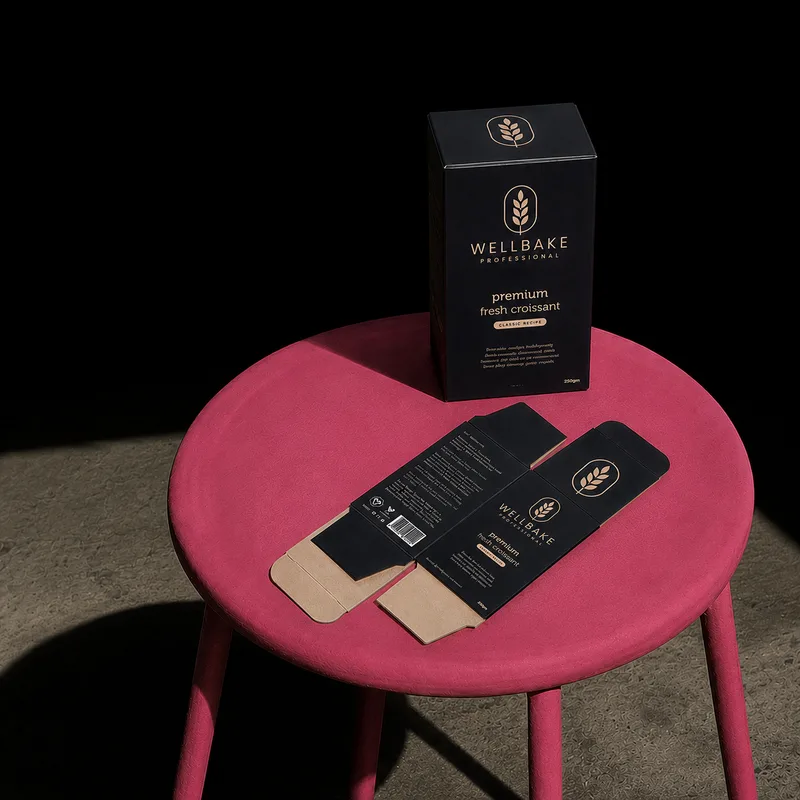
Reverse Tuck Box
Tucks hinge from opposite panels; everyday re-openable retail carton.
From $0.67/unit
2 answers →Why a carton bottom opens under weight, which of the five tuck structures suits your product and packing line, how to size around caps and pumps and where required copy fits. Each answer gives the cause first, then the carton that solves it.
Each answer below is linked to the product it applies to. Pick a product to see its answers, open its page for sizes and pricing, or compare the full tuck boxes packaging range.
Tucks hinge from opposite panels; everyday re-openable retail carton.
From $0.67/unit
2 answers →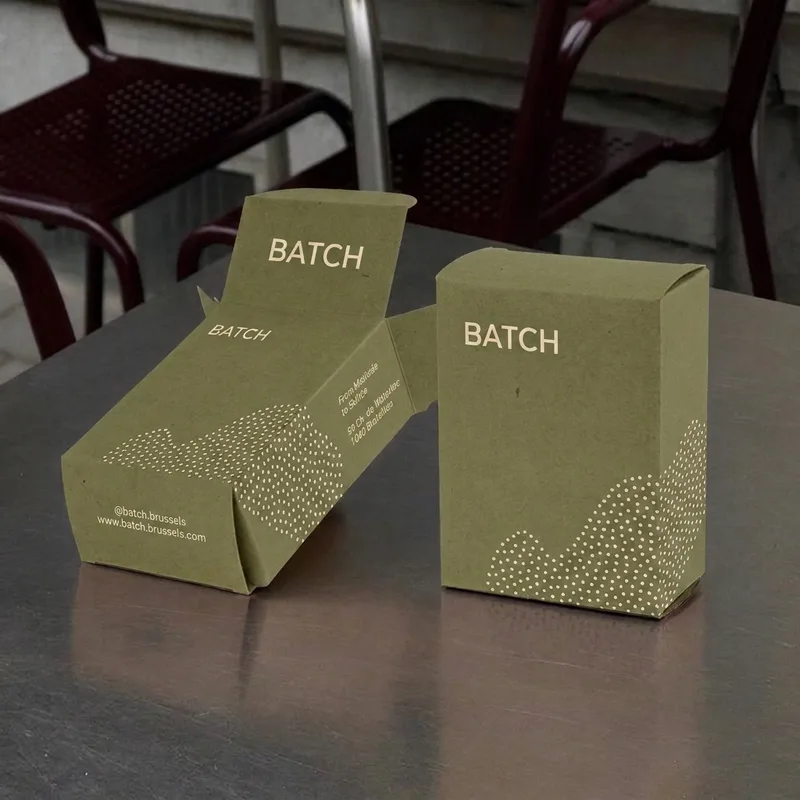
Both tucks hinge from the same panel for a clean, consistent front.
From $0.67/unit
1 answers →
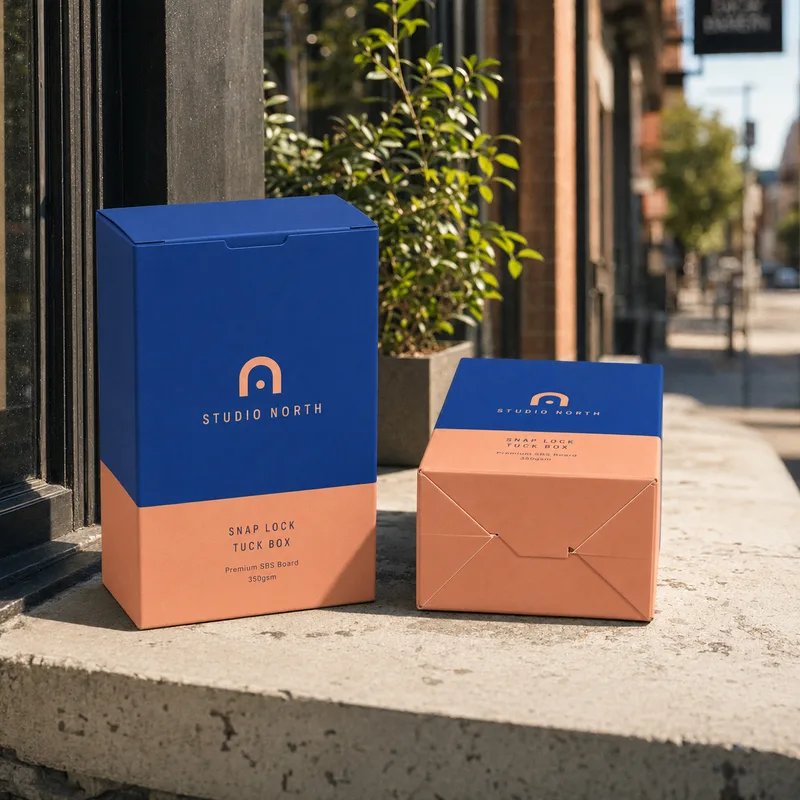
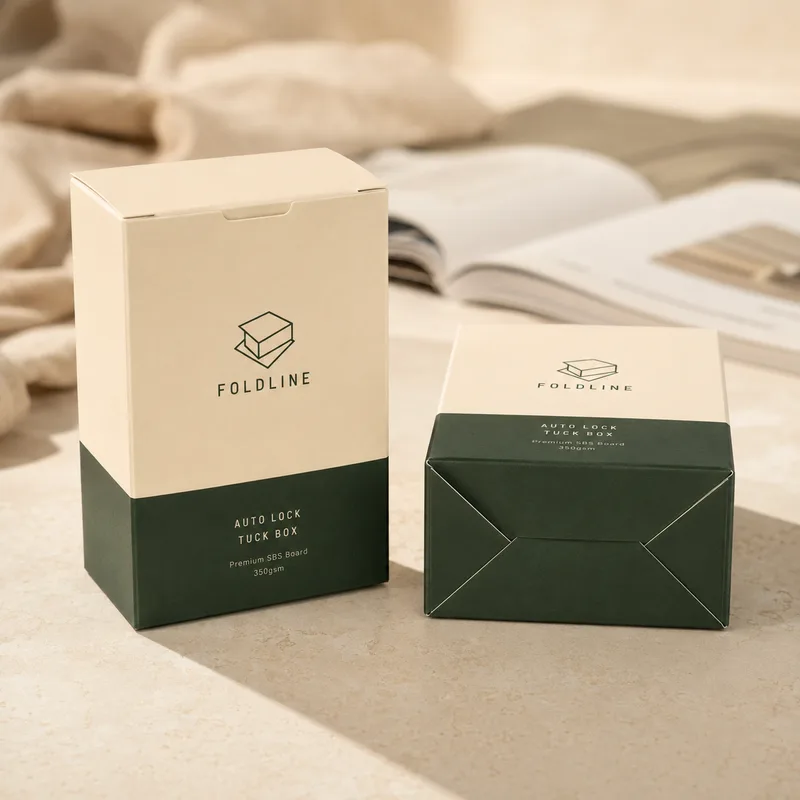
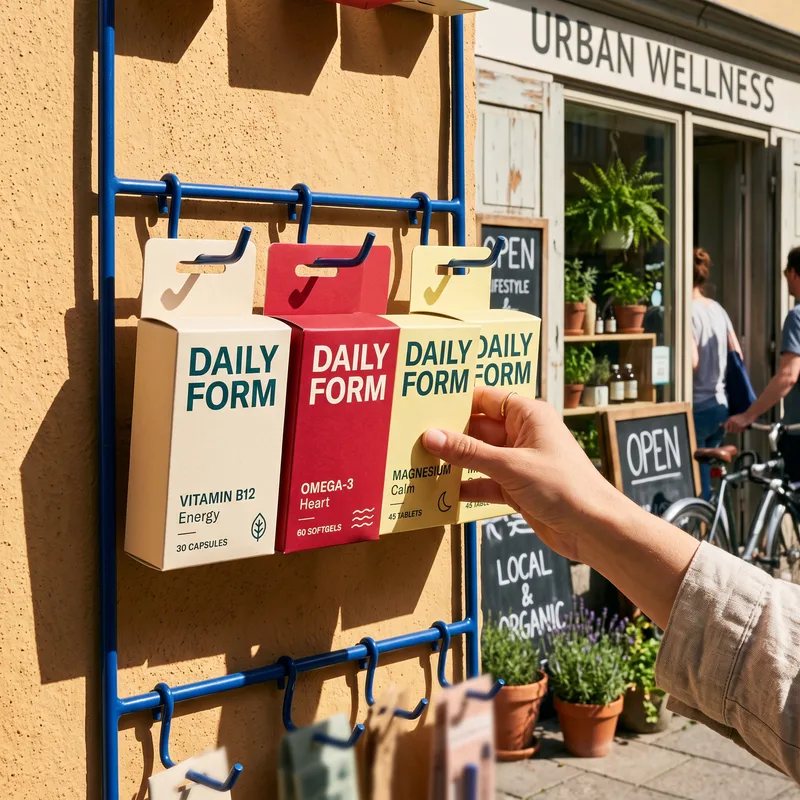
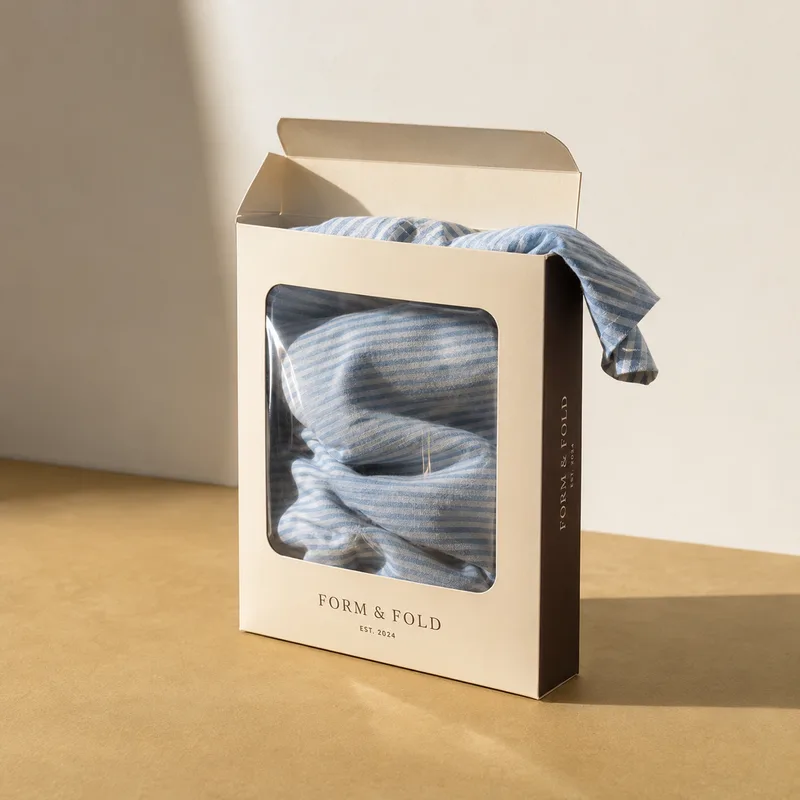
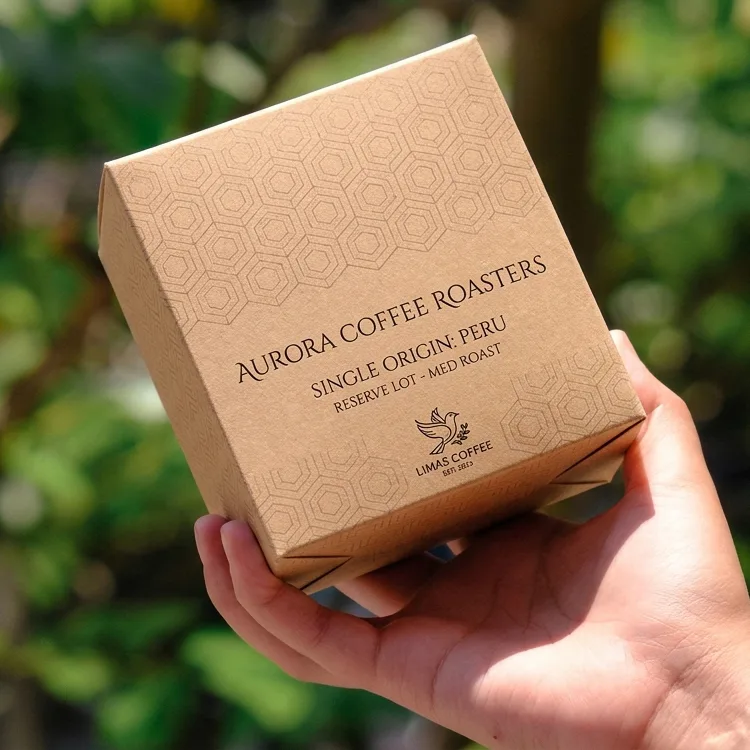
Recycled-content or documented board, finishes chosen for end of life.
From $1.25/unit
1 answers →A tuck box is a folding carton made from a single paperboard blank, glued at the side seam, that closes with tuck flaps or a locked or sealed bottom. It ships flat, sets up quickly at packing, and is the standard retail carton for cosmetics, soap, supplements, food and small goods.
Tuck flap
The tongue that slides into the carton to close an end.
Dust flaps
Small side flaps under the tuck that close the gaps.
Folding carton
Paperboard packaging that ships flat; a rigid box arrives set up.
Caliper (pt)
Board thickness in thousandths of an inch; 18 pt is about 0.46 mm.
Most tuck box problems trace back to the bottom closure, the inside size or the panel plan. Open a problem to see why it happens and what fixes it.
Why it happensA tuck bottom is held shut by one flap pushed into the carton. A heavy product presses straight down on that flap and slowly levers it out, most of all when the carton is picked up from the top.
How to fix itUse a locked bottom: Auto Lock (pre-glued, forms as the carton opens) or Snap Lock (folded and interlocked by hand). Both carry weight on several interlocked panels.
Why it happensThe carton was sized loose, or to a different size of the product, so it moves every time the box is handled. Movement scuffs labels and can crack glass.
How to fix itSize the opening to the product plus 1–2 mm, or hold it with an insert sized to the product.
Sizing ↓ →
Why it happensThe tuck flap isn't seated deep enough, a stiff crease pushes it back out, or the product presses on the closure from inside. Each one lets the flap work loose with handling.
How to fix itCheck tuck depth and crease on a filled sample, add 2–3 mm depth over the product, or move to a Seal End or locked structure if the carton must stay shut.
Why it happensInside depth was set to the product, but each tuck flap folds into the carton and takes up space above the product. The flap then pushes on caps and pumps.
How to fix itAdd 2–3 mm to depth over the tallest point so both tucks seat without touching the product.
Sizing ↓ →
Why it happensFilled glass is heavy for its size. Light board bends under that weight, so the base bows and the carton loses its square shape on shelf.
How to fix itRaise the board grade (toward 20–24 pt) or use an Auto Lock bottom, and check on a packed sample with the filled product.
Board ↓ →
Why it happensTuck ends are designed to re-open, so shoppers can open them to look inside and close them again without a trace.
How to fix itUse a Seal End box: the ends seal with a peel-and-seal strip and stay closed until first opened.
Why it happensThe front panel was asked to carry the brand, claims, net quantity and required copy at once, so text shrinks below a readable size.
How to fix itKeep identity and net quantity on the front and move ingredients, directions and secondary copy to side and back panels.
Why it happensThe window was placed from the artwork, not the product's packed position, so it frames empty board or the insert.
How to fix itSet the window from where the product sits, or add an insert that holds the product behind the window.
Why it happensTuck and Snap Lock bottoms are folded by hand on every carton, which adds several steps per unit across a large run.
How to fix itChoose an Auto Lock bottom: it is pre-glued and forms in one motion as the carton is opened.
Choose by how the bottom forms and whether the carton re-opens. Reverse Tuck suits everyday re-openable retail cartons. Straight Tuck End gives a consistent front. Auto Lock forms a pre-glued bottom in one motion for heavier products. Snap Lock locks by hand with no pre-glue. Seal End stays closed until opened.
| Reverse Tuck | Straight Tuck | Auto Lock | Snap Lock | Seal End | |
|---|---|---|---|---|---|
| Bottom | Tuck, opposite side | Tuck, same side | Pre-glued, forms on opening | Hand-locked flaps | Peel-and-seal |
| Bottom steps at packing | Tuck in | Tuck in | One motion | Several folds | Peel and press |
| Re-openable | Both ends | Both ends | Top only | Top only | No |
| From | $0.67 | $0.67 | $0.79 | $0.77 | $0.70 |
| Best fit | Everyday retail | Front-led retail | Fewer bottom steps | No pre-glue | Closed until opened |
Product cartons start from a structure and add the insert, window, board or panel layout one product needs: a jar ring, a bottle neck, a stick slot, a cake board base or supplement facts panels. Start from your product, then open its page for sizing and options.
| Product | Cartons | From |
|---|---|---|
| Serums, jars, lipstick | Serum Boxes · Skincare Jar Boxes · Lipstick Boxes | $0.62 |
| Cologne | Cologne Boxes | $0.69 |
| Soap bars and sets | Soap Tuck Boxes · Handmade Soap Boxes · Kraft Soap Boxes · Soap Gift Packaging | $0.65 |
| Candles | Candle Boxes · Kraft Candle Boxes · Candle Gift Boxes | $0.73 |
| Cakes and pastries | Cake Boxes ($1.13) · Pastry Boxes ($0.77) · Bakery Boxes with Window ($0.83) · Donut Boxes · Kraft Bakery Boxes | $1.13 |
| Candy and chocolate | Candy Boxes · Chocolate Boxes · Candy Gift Boxes · Lollipop Boxes | $0.71 |
| Snacks and tea | Snack Boxes · Tea Boxes | $0.81 |
| Supplements and medicine | Supplement Boxes · Medicine Boxes | $0.72 |
| Apparel and shoes | Clothing Tuck Boxes · T-Shirt Boxes · Shoe Boxes | $1.25 |
Note: Industry guidance: Cosmetics · Soap · Candle · Bakery · Candy & Sweets · Food & Beverage · Pharma · Apparel · Tea & Coffee.
Most retail cartons use about 18–20 pt paperboard: skincare, soap and supplements. Use 14–16 pt for light items such as cards and sachets, 22–24 pt for larger cartons and heavier contents, 26–28 pt for large and multi-unit packs, and E- or F-flute corrugated for heavier products or extra edge strength.
| Board | Typical thickness | Typically suited to |
|---|---|---|
| About 14–16 pt | About 0.36–0.41 mm | Cards, small cosmetics, sachets |
| About 18–20 pt | About 0.46–0.51 mm | Most retail cartons: skincare, soap, supplements |
| About 22–24 pt | About 0.56–0.61 mm | Larger cartons and heavier contents |
| About 26–28 pt | About 0.66–0.71 mm | Large cartons and multi-unit packs |
| E- or F-flute corrugated | About 0.8–1.6 mm | Heavier products or extra edge strength |
| B-flute corrugated | About 3 mm | Large or multi-unit cartons |
Measure the product at its largest points, including caps and pumps. Add about 1–2 mm (1/16 in) to the opening's length and width so it slides in, and 2–3 mm to depth so both tucks seat without pressing the product. With an insert, size to the insert. Each outside dimension grows by about two board thicknesses.
| Step | Typical allowance |
|---|---|
| Product to inside length and width | +1–2 mm (1/16 in) |
| Product to inside depth | +2–3 mm, so the tucks seat |
| With an insert | The insert's outer dimensions |
| Inside to outside | About two board thicknesses per dimension |
A window shows the product: open die-cut for soap bars and wrapped items, or a clear PET film patch for cosmetics, loose items and wrapped food. A hang tab is part of the carton blank, so it prints with the box and needs no extra step, for products sold on peg hooks.
| Open die-cut window | Clear-film window | |
|---|---|---|
| Covering | Nothing | PET film glued inside |
| Product | Can be touched | Covered |
| Typical fit | Soap bars, wrapped items, accessories | Cosmetics, loose or textured items, food in its own wrap |
| Extra step | None | Window patching |
Other add-ons: tongue lock, tear strip, plastic handle (Auto Lock), inserts in paperboard, foam/EVA, molded pulp or thermoformed PET/PVC.
Note: The hang tab is standard on Straight Tuck End and on request for the other four structures.
By offset, digital, UV or screen printing, in CMYK and Pantone spot colors, on the exterior, exterior and interior, or full inside and outside. Plan the front for identity and net quantity and the side or back panels for ingredients, directions and warnings, so required copy never crowds the brand.
Coatings
Aqueous or grease-resistant coating; matte, gloss or soft-touch lamination.
Finishes
Foil stamping, emboss, deboss, Spot UV and raised 3D UV.
Supplements
A Supplement Facts panel planned for the supplied label copy.
OTC medicine
Drug Facts and codes from approved artwork; tamper-evident features are specified and validated separately.
Cosmetics
Display panel for identity and net quantity, information panel for ingredients.
Dieline
A custom dieline with free design support.
Note: Label content is supplied and confirmed by the brand.
Send the product dimensions with cap or pump, filled weight, structure, board, print coverage and any required copy panels. Quotes typically come back within 24 hours; orders dispatch 7 days after proof approval, plus shipping time, with rush available, and orders start at 500 units. Cartons ship flat. Every structure and product carton is on the tuck boxes page.
Most tuck boxes are recyclable, depending on the paperboard and finishes used. Sustainable Tuck Boxes use recycled-content or responsibly sourced documented board, choose finishes for end of life, and avoid or specify laminations and films. FSC is used only when confirmed for the material and supply chain.
Each structure below has a free template generator: enter your size and download a PDF, SVG, DXF or PNG file with bleed and safe zone marked. Before you order, open it in the 3D mockup generator to see your artwork on the folded pack.
All structures in one place: dieline generator.
Packaging Dock makes custom tuck boxes to order (five structures, three variants and product cartons for beauty, food, candy, soap, candles, apparel and supplements) from 500 units, and ships them flat across the USA and worldwide. These are the questions retail and DTC brands ask most. All cartons are on the tuck boxes page.
No answers for this product in this topic.
Reverse tuck hinges its tucks from opposite panels and can fit efficiently for many proportions; straight tuck hinges both from the same panel, so both ends open toward the same side and the front reads cleanly.
A bottom that is pre-glued in production so it forms in one motion: open the flat carton, square it, and the bottom locks. It carries more weight than a tuck bottom and removes the bottom folding step at packing, so it suits larger runs and heavier products. See Auto Lock Box.
A bottom made of four flaps that are folded and interlocked by hand in sequence, with no glue at the base. It locks under weight like an Auto Lock but takes a few seconds per carton at packing, so it suits smaller runs. See Snap Lock Box.
A tuck box closes with folded flaps and is built for presentation; a mailer uses a locking structure built for shipping. Ship tuck boxes inside a mailer or shipping carton.
A tuck box is lighter paperboard that ships flat; a rigid box holds a fixed shape and arrives set up, for gift-led and higher price points.
No, and that is the point. The ends seal with a peel-and-seal strip, so once opened they stay visibly open. That keeps the carton closed on shelf until purchase and leaves clean ends with no visible tuck. See Seal End Box.
Most retail cartons use about 18–20 pt paperboard: skincare, soap and supplements. Light items such as cards and sachets can use 14–16 pt; filled glass and larger cartons move to 20–24 pt or more, or an Auto Lock bottom. The final grade is confirmed on a packed sample.
Yes. Tuck structures are made in E-, F- or B-flute corrugated for heavier products, larger cartons or extra edge strength. Corrugated is thicker, so inside dimensions and folds are set for the flute on the dieline.
Choose by the look. White SBS prints full color, photography and fine detail accurately; kraft gives a natural brown look where simple, dark artwork reads best because the brown board shows through the ink.
Inside dimensions: the space the product needs. The carton is built around them. How much larger the outside ends up depends on the structure, closure and board, so ask for outside dimensions on the proof when shipping cartons or shelf space depend on them.
Jar or tin height with the lid, widest diameter and filled weight; pillars by diameter and height; tapers by length and base diameter.
An integrated tab is part of the blank and prints with the box, with no extra packing step; an adhesive hanger is added later and is usually plain.
A large window removes board from a panel, so that panel can bow, most of all on a tall carton or under a heavy product. Reduce the window, keep it away from folds and the bottom, or raise the board grade.
Yes: paperboard, foam/EVA, molded pulp or thermoformed PET/PVC inserts, depending on the structure and product. An insert holds the product in place, behind a window or apart from other items, and the carton is sized to its outer dimensions.
Food-contact board is available on request; all food-contact surfaces (board, coating, inserts, film) are confirmed for the food type, contact time and temperature.
Only when the insert or inner surface is confirmed for food contact. Otherwise unwrapped candy sits in its own wrap, bag or a food-contact insert, and the printed carton is the outer layer.
Not by default. Tamper-evident features, such as a Seal End closure, are specified and validated separately for the product and its requirements. See Medicine Boxes.
Supplement cartons carry a Supplement Facts panel and structure/function claims; OTC drug cartons carry Drug Facts under drug rules.
From $0.67 per unit for Reverse Tuck and Straight Tuck End, $0.70 for Seal End, $0.77 for Snap Lock and $0.79 for Auto Lock at 500 units. The final price depends on size, board, print coverage, finishes and quantity.
Yes, in two ways: a sample of your carton before bulk production, to check fit with the product; and a complimentary sample kit of materials and finishes to compare board and print.
They're built for the shelf, not the parcel network: thin board and tuck ends don't survive carrier handling on their own. Ship them inside a mailer or shipping carton. See Shipping & Logistics.
Different names for the same thing: a single printed folding carton that holds one product for sale. Tuck boxes are the most common type.
The side seam is glued in production, so the carton ships flat. Open it, form the bottom (tuck in, fold the Snap Lock sequence or let the Auto Lock form), load the product and tuck the top. No tape or glue is needed at packing; Seal End uses its peel-and-seal strip.
Yes. Tuck boxes arrive flat, glued at the side seam, and set up at packing: Auto Lock bottoms form as the carton opens; tuck, Snap Lock and Seal End ends are folded or sealed by hand.
The glue flap (manufacturer’s joint) is the side seam glued in production. Dust flaps are the small side flaps under each tuck. A friction lock holds the tuck by fit; a slit lock adds cuts that catch the tuck so it stays closed.
SBS (solid bleached sulfate) is smooth white paperboard for full-color print. Caliper in pt is thickness in thousandths of an inch (18 pt is about 0.46 mm); gsm is weight per square meter.
Offset gives consistent, high-resolution print and is the usual choice for larger runs; digital suits shorter runs and artwork that changes per SKU. Both print CMYK and Pantone spot colors.
Process colors vary with stock and press. Specify Pantone spot colors for brand colors and approve each run against a proof.
Heavy coverage or lamination over a score can crack; board too heavy for the scores makes it worse. Unprotected print scuffs in transit; aqueous coating or lamination protects it, and shipping inside a mailer stops rubbing.
Size, contrast, print quality or placement. Keep it on a flat panel at a scannable size and test-scan the printed sample.
Start from the custom dieline: identity and the key benefit on the front, required copy on side and back panels, and one clear hierarchy. Any design tool, including Canva or Illustrator, works on the dieline; free design support and a proof come with every order.
A window shows the product and sells on sight; full print gives every panel to the brand and blocks light.
That’s a legal question; we can’t advise on copyright or trademarks. We don’t reuse a customer’s artwork.
Cartons are made to your dimensions; larger or heavier ones move to heavier board or E-, F- or B-flute, and very heavy products suit a mailer instead.
Every run has fixed setup work (dieline, plates or files, press setup) that is shared across the boxes. At small quantities each box carries more of that setup, so the unit price drops as quantity rises.
Packaging Dock makes custom tuck boxes to order from 500 units, priced by quantity and shipped flat across the USA and worldwide.
Yes, when the products share a size: one structure and dieline, with the artwork changed per SKU. Different sizes need their own dielines.
Pack them snug in a shipping carton or mailer with dividers so they don’t rub; tuck boxes aren’t built to ship alone.
No. Custom printed boxes are made to your artwork and size, so they can't be resold as stock. A pre-production sample and proof are there to catch issues before the run.
Yes, as printed cartons for light pieces, gift sets and seasonal editions. Fine jewelry and keepsakes usually go in rigid boxes.
Yes: cosmetic sample cartons sized to the minis, and bakery boxes with a clear PET window over the cookies, with food-contact board on request.
Jar: widest diameter and height with the lid, plus filled weight. Cake: from the cake board and the tallest point including toppers.
A tuck box encloses the product and stands on the shelf. A pillow box suits light favors and samples. A sleeve over a stock box changes the look per SKU without a new carton run.
Paperboard gift cartons mostly are, depending on finishes. A PET window or plastic lamination changes how the carton is handled, so check local rules. See Sustainable Tuck Boxes.
Ready to put it together?
Answer a few questions and get a packaging setup with the reason for every choice, or browse every tuck boxes product.