Overview & Specifications
What Is a Flip Top Rigid Box?
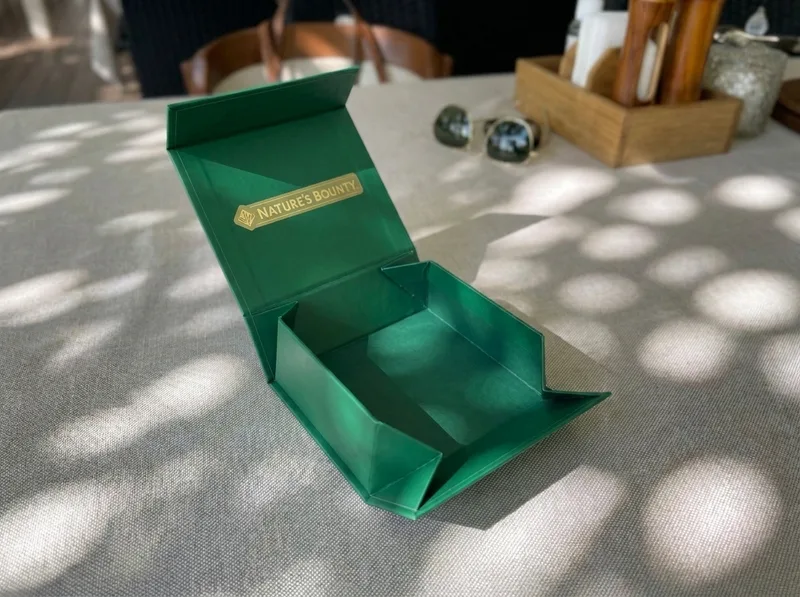
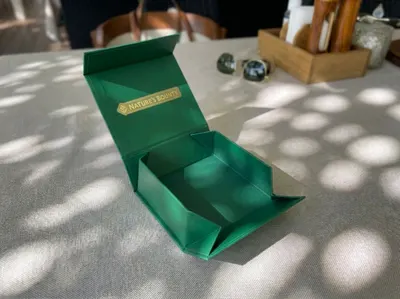
A flip top rigid box is a setup box with a rigid base and a rigid lid joined by a paper-wrapped spine: a narrow flexible strip where the wrap bridges the gap between the lid board and the base. The lid lifts open from the front and stays attached, and the front edge forms the closure area, where magnets or a friction fit hold the lid shut. Once open, the lid stands behind the base and its inner face becomes a display panel.
How the Lid Opens and Closes
The format works through three linked zones.
01
Wrapped Spine
Lid and base are joined by the wrap across a narrow gap in the board. The spine flexes each time the lid opens and sets how far it rotates and where it rests.
02
Front Closure Area
The front of the lid meets the front of the base. Magnets hidden under the wrap, or a close friction fit, keep the lid down until it is lifted.
03
Inside-Lid Panel
When the lid is up, its full inner surface faces the person opening the box, ready for artwork, instructions or a card pocket.
Anatomy of a Flip Top Rigid Box
-
01
Lid
Top panel, lid walls and inner face; lifts from the front.
-
02
Wrapped Spine
Flexible paper-wrapped joint between lid and base.
-
03
Front Closure Area
Front edge where magnets or a friction fit secure the lid.
-
04
Base
Holds the product and any insert.
-
05
Insert
Optional fitted insert, compartments or pocket.
The inside lid is seen at the same moment as the product, so plan it as a spread with the insert. Keep foil, Spot UV and fine type off the spine, where the wrap flexes on every opening.
Front-Lift or Book-Style Orientation
The same wrapped-spine construction can be oriented two ways.
| Orientation | Where the Spine Sits | Typically Suited To |
|---|---|---|
| Classic flip top | Along the back; the lid lifts from the front | Sets and kits with an inside-lid message |
| Book style | Along one side; the cover opens like a hardcover | Gift sets, launches and story-led reveals |
Front Closure Options
The closure is chosen per project; no single closure is built into the format.
| Closure | How It Holds the Lid | Typically Suited To |
|---|---|---|
| Magnetic closure | Concealed magnets in the lid front and base front pull the lid shut | A defined closing action and a box opened many times |
| Friction fit | Close lid-to-base tolerances keep the lid down | Lighter contents and a simpler build |
| Other approved detail | Ribbon, hook-and-loop dot or other detail agreed at dieline stage | Special opening or closing requirements |
Application guide
When Is a Flip Top Rigid Box the Right Choice?
A flip top rigid box works well when the lid should stay with the box and the inside lid should carry a message, such as fragrance and beauty sets, jewelry gift boxes, corporate and PR kits, fashion accessories and book-style gift presentations. Nothing is set aside during opening, so the box presents as one piece.
-
01
One
One Piece in the Hand
No separate lid to put down, which keeps the presentation intact at retail, in a gift exchange or on camera during an unboxing. -
02
Inside
Inside Lid as a Display Panel
The lid's inner face is seen upright behind the product, a strong spot for a thank-you message, instructions or a campaign line. -
03
Defined
Defined Closing Action
A magnetic front closure gives a clear snap shut, useful for boxes reopened during use, such as kits and accessory storage. -
04
Alternative
When Another Format May Fit Better
If the box must ship and store flat before packing, choose a Collapsible Rigid Box. For a compact ring, bracelet or necklace case on a defined hinge, see the Hinged Rigid Box. For a fully removable lid, a Two Piece Rigid Box or a Shoulder Neck Rigid Box fits better, and a Custom Drawer Box suits a sliding reveal.
Flip Top Rigid Box Specifications
Custom flip top rigid boxes are specified around lid geometry, the wrapped spine, front closure, board, wraps, inside-lid print, inserts and finishes, with the base and attached lid built to custom dimensions around the product, its insert and the chosen opening orientation.
| Specification | Available Configuration |
|---|---|
| Product Type | Attached-lid flip top setup rigid box |
| Category | Rigid Boxes |
| Dimensions | Custom L × W × H, built around the product, insert and lid geometry |
| Core Construction | Rigid base + integrated rigid lid joined by a paper-wrapped spine |
| Orientation | Front-lift flip top or side-opening book style |
| Front Closure | Magnetic, friction fit or other approved detail where specified |
| Base Board | Greyboard, or white-coated duplex board for a cleaner white face |
| Board Thickness | 1.5 mm, 2.0 mm, 2.5 mm or 3.0 mm |
| Wrap Paper | Art, custom printed, kraft, metallic, holographic, pearlescent or textured paper, or fabric/velvet wrap; paper commonly around 120–157 gsm |
| Inserts | Paperboard, foam/EVA or molded pulp; fabric-lined foam and thermoformed PET/PVC trays also offered for rigid boxes |
| Interior | Inside-lid print, pocket or card slot, compartments, satin lining |
| Print Coverage | Exterior only, exterior + interior lid, or full inside and outside |
| Print Methods | Offset, digital, UV or screen printing; CMYK and Pantone spot colors |
| Finishes | Matte, gloss or soft-touch lamination, foil stamping, emboss/deboss, Spot UV and raised 3D UV |
| Spine and Closure Fit | Spine movement, lid alignment and closure confirmed from final construction on sample |
| Starting Price | From $2.85 / unit; final price depends on size, board, closure, inserts, finishes and quantity |
| Minimum Order | 500 units |
| Standard Production | 7 days from approved proof |
| Rush Production | Available on request |
| Shipping | USA and worldwide |
How Flip Top Boxes Compare to Other Rigid Box Structures
All three attached-lid formats keep the lid with the box; they differ in how lid and base are joined and how the box arrives.
| Attribute | Flip Top Rigid Box | Hinged Rigid Box | Collapsible Rigid Box | Two Piece Rigid Box |
|---|---|---|---|---|
| Lid connection | Paper-wrapped spine | Defined hinge mechanism | Flip-top style lid once assembled | None, lid lifts fully off |
| Arrives | Set up, ready to pack | Set up, ready to pack | Flat, assembled before packing | Set up, ready to pack |
| Closure | Magnetic, friction or other | Friction, magnetic, ribbon or other | Corner lock, adhesive or magnetic elements | Lid-to-base fit |
| Signature surface | Inside lid seen upright | Insert and inner lid at close range | Flip-top reveal after assembly | Lid top and base band |
| Best fit | Sets, kits, book-style gift boxes | Ring, bracelet and necklace cases | Brands storing many empty boxes | Full-access gift and retail boxes |
What Size Flip Top Rigid Box Do You Need?
Size the base from the product outward, then size the attached lid to cover the base. The base interior holds the product with clearance, the walls add board and wrap, and the lid must cover the base while leaving room at the spine and front closure, and above any insert or pocket, for the lid to close cleanly.
How Base and Lid Sizes Relate
The figures below are planning references, not fixed manufacturing rules; final allowances depend on product shape, insert, board, wrap and closure.
| Step | Typical Allowance |
|---|---|
| Product to base interior (no insert) | Add about 2–3 mm to length and width, 2–5 mm to height |
| Base interior to base exterior, 1.5 mm board | About +4–5 mm per dimension |
| Base interior to base exterior, 2.0 mm board | About +5–6 mm per dimension |
| Attached lid over the base | Sized to the base exterior plus spine and closure clearance on the dieline |
| Magnets (where specified) | Small concealed discs, around 10 × 2 mm, can serve as a starting reference on suitable builds; final diameter, thickness, count and placement are set around the lid and closure force |
Typical Board Selection Starting Points
| Box Size (longest side) | Typical Board |
|---|---|
| Up to about 150 mm (6 in) | About 1.5–2.0 mm |
| About 150–250 mm (6–10 in) | About 2.5 mm |
| Over about 250 mm (10 in), or contents over about 1 kg | About 3.0 mm |
Important: Treat these numbers as reference values. A rigid box is typically held to about ±1–2 mm, and wrap moisture can shift fit slightly, so magnet pull, spine movement and lid alignment are checked together on a sample.
If you are unsure, share the product dimensions and weight with the quote request, and the box is sized around them.
Does the Lid Need to Open Flat?
Not usually. Most flip top boxes are designed so the lid rests at a comfortable angle behind the base, and spine width and lid depth set that angle. If the lid must lie fully back for display, state it in the brief so the dieline allows for it.