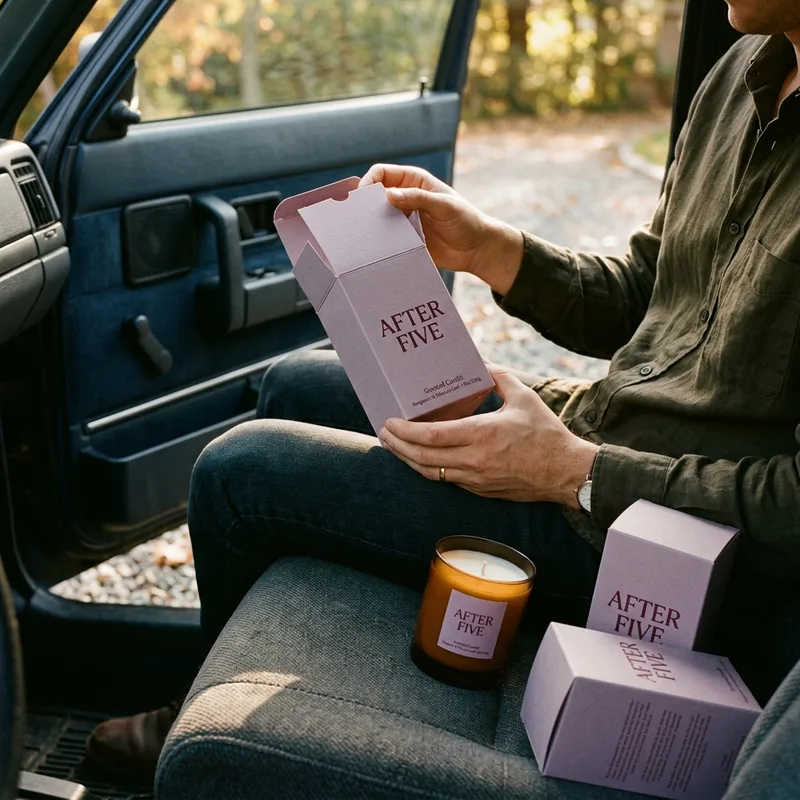
Custom Candle Boxes
Printed folding cartons with a locked base, sized to one jar, tin, pillar or taper.
From $0.73/unit
10 answers →Why a jar rattles or cracks in the mail, which box and base carry the weight of filled glass, how to size around a lidded vessel, and where the warning copy goes. Each answer explains the cause first, then points to the packaging that solves it.
Each answer below is linked to the product it applies to. Pick a product to see its answers, open its page for sizes and pricing, or compare the full candle packaging range.
Printed folding cartons with a locked base, sized to one jar, tin, pillar or taper.
From $0.73/unit
10 answers →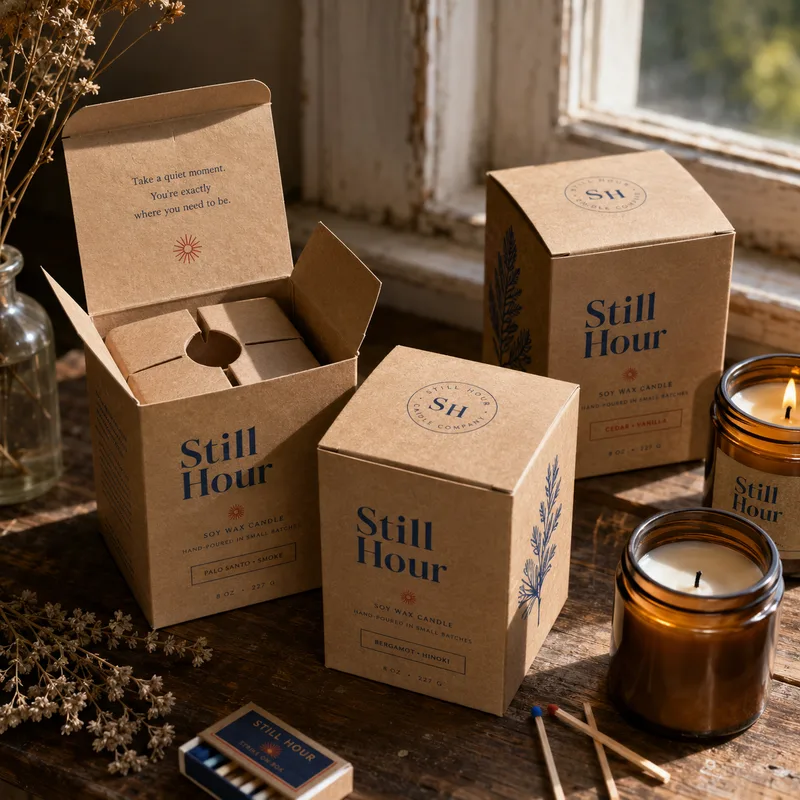
Locked-bottom cartons in brown kraft board, printed for the brown surface.
From $0.73/unit
2 answers →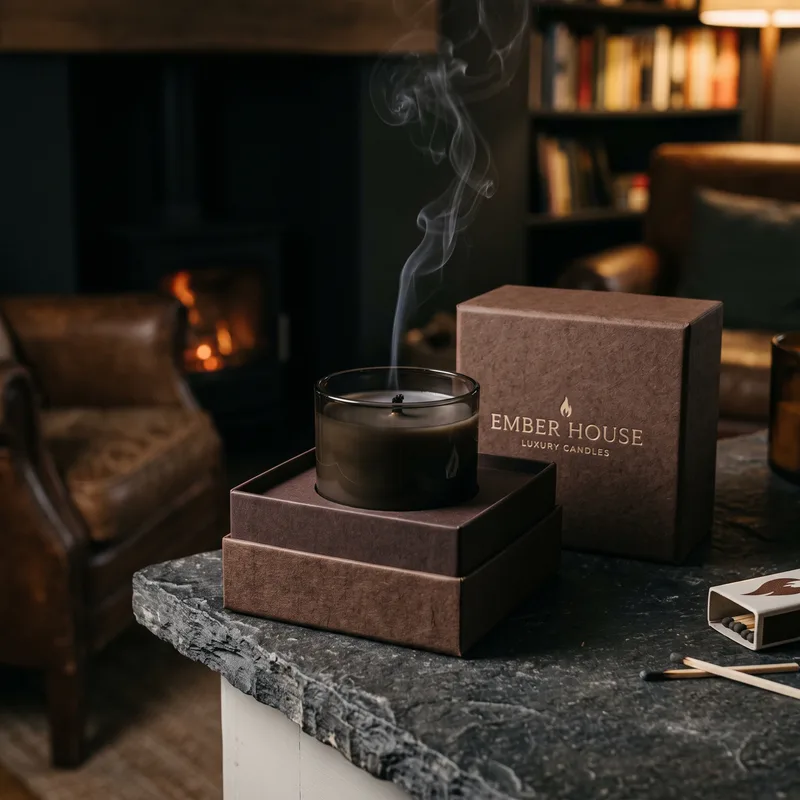
Shoulder neck rigid boxes: the lid lifts off over a neck that keeps the vessel centered.
From $1.25/unit
6 answers →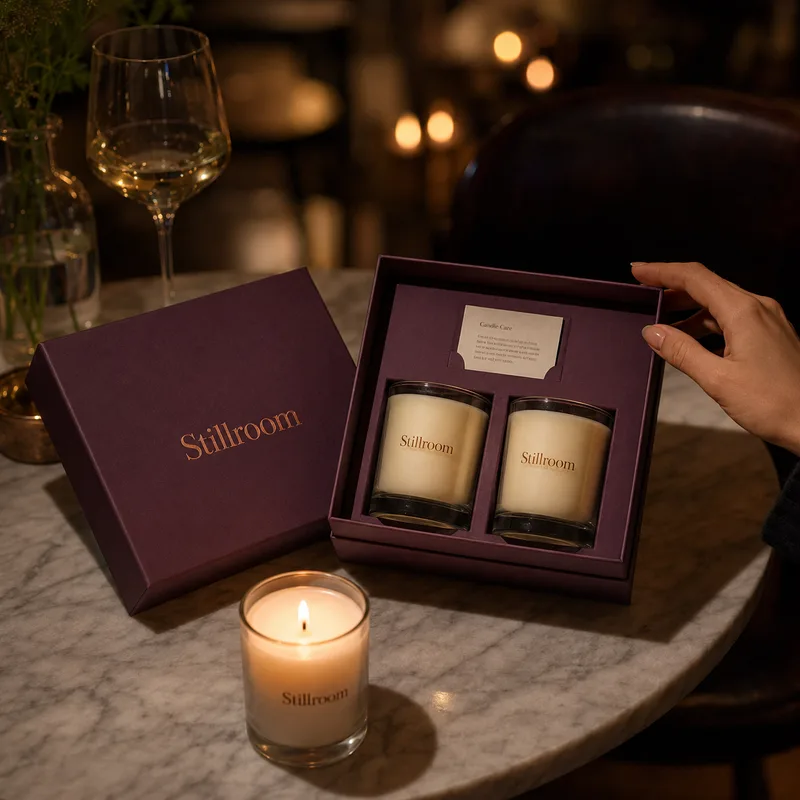
Folding gift cartons with a cavity for each candle and accessory.
From $1.25/unit
3 answers →
Most candle packaging failures come from three things: a heavy glass vessel that can move, a base that wasn't chosen for the filled weight, and measurements taken without the lid. Open a problem to see why it happens and what fixes it.
Why it happensWithout an insert, the gap between the round jar and the square carton lets the jar slide. A filled jar is heavy, so every bump in transit turns that gap into an impact against the walls.
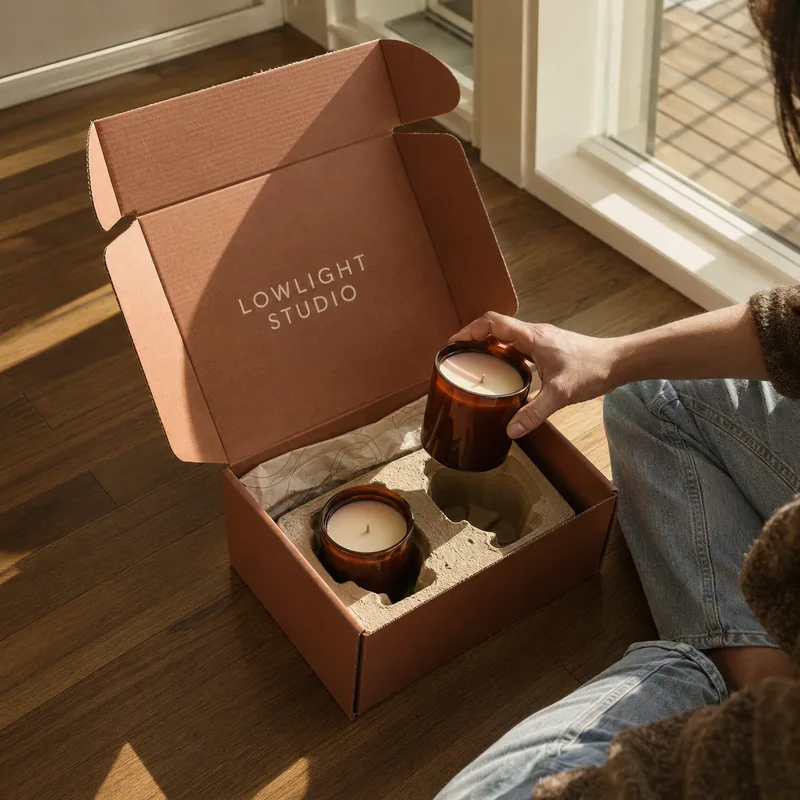
How to fix itAdd an insert cut to the jar: paperboard for a single jar, foam/EVA for a snug gift fit, or molded pulp for cushioning. Size the carton to the jar plus the insert.
Why it happensA plain tuck bottom or light board carries the jar's weight on folded flaps alone. The weight pushes the flaps apart, most of all when the box is lifted by its sides.
How to fix itUse a locked base (Auto Lock or Snap Lock) and step up the board from 14–18 pt toward 26–28 pt, or move to E/F-flute corrugated, for heavier vessels. Confirm on a packed sample.
Why it happensHeight was taken from the jar or the label volume, not the filled vessel with its lid. Wooden and metal lids add height and often overhang the jar.
How to fix itMeasure height with the lid on and the widest diameter (often the lid), then add the insert. Check the fit on a sample with your actual vessel.
Why it happensVessels touch each other, so the carton's movement becomes glass-on-glass contact. Dividers that are too short or too loose let jars tip into each other.
How to fix itSeparate every vessel with an insert or divider sized to the filled jar, and keep the load from shifting. Trial-pack the actual candles for your route.
Why it happensThe shipping box was sized to the empty retail box, not the packed height with inserts. Pressure on the lid can crack it or push the jar down.
How to fix itSet the mailer's inside height from the packed retail box or vessel plus support, and leave closing clearance.
Why it happensBoxes or sleeves look alike from the end the packer sees, so a wrong scent goes into the right box.
How to fix itPrint a scent name or code on the sleeve or box end, and use a sleeve per scent over one plain box.
Why it happensThe safety text was squeezed onto the front with the brand, or a sleeve covers it.
How to fix itGive the warning its own panel (side, back or base) and check it stays visible with any sleeve or gift wrap on.
Start from how the candle is sold. A shelf candle needs a carton with a locked base; a gift candle a rigid box or a set box; a large scent range a sleeve over one plain box; an online order a shipping box. Compare every option side by side on the candle packaging page.
Comparisons
Folding carton vs rigid box
A folding carton ships flat, sets up in seconds and suits shelf retail at volume; a rigid box arrives set up, feels heavier in the hand and suits gifts. Both take an insert.
Printed box vs sleeve
A printed box per scent suits a few scents and a one-piece look; a sleeve per scent over one plain box suits ranges that change often, because only the sleeve is reprinted.
Box vs label only
A label brands the vessel at the lowest cost; a box adds shelf presence and protects the glass. Many makers start with labels and add a box for gifts and retail.
Structure detailTuck Boxes guide →Rigid Boxes guide →Custom Sleeves guide →
A filled glass jar is heavy for a folding carton, so candle boxes use a locked base rather than a tuck bottom. The base holds the weight; the board grade stops the panels from bowing. Both are chosen for the filled weight and confirmed on a packed sample.
| Auto Lock base | Snap Lock base | |
|---|---|---|
| How it forms | Pre-glued in production; opens into place as the carton is squared | Four flaps folded and interlocked by hand |
| Packing speed | Fastest: no bottom folding at packing | Slower: folded box by box |
| Best for | Larger runs and repeat packing | Smaller runs; no pre-gluing needed |
| Weight | Carries a filled jar | Carries a filled jar |
Board grades on candle boxes
Paperboard 14–18 pt
Tins, votives and lighter jars.
Paperboard 20–24 pt
Most single glass jars on a shelf.
Paperboard 26–28 pt
Heavier jars and multi-wick candles.
E/F-flute or B-flute corrugated
Heavy vessels, sets and boxes that also travel by parcel.
Note: Board guidance is a starting point. The final grade is set from the filled weight, the carton size and how it is handled, and checked on a sample with your actual vessel.
LinksCustom Candle Boxes →Auto Lock Box dieline →Snap Lock Box dieline →
For glass, usually yes. A round jar in a square carton leaves gaps at the corners, and a heavy jar uses that space to build momentum in transit. An insert centers the vessel so the carton walls, not the glass, take the bumps. Leave clearance for the lid, label and any wooden or metal lid overhang, and check that the jar lifts out without catching.
| Insert | How it holds the candle | Best for |
|---|---|---|
| Paperboard | A die-cut collar or platform that centers the jar | Single jars in a folding carton; paper-only packaging |
| Foam / EVA | A cut cavity that grips the vessel closely | Rigid gift boxes and snug presentation |
| Molded pulp tray | A formed cavity that cushions and separates | Shipping boxes and multi-candle sets |
| No insert | The carton is sized tight to the vessel | Tins, pillars and lighter candles that can't shift |
LinksCustom Candle Boxes →Rigid Candle Boxes →Candle Gift Boxes →
Measure the real filled vessel with its lid on, not the volume on the label. Two jars sold as 8 oz can differ completely: a jelly jar is about 3.75 in tall and 2.5 in wide, a tureen jar about 2.5 in tall and 3.8 in wide. Record the filled weight too, since it sets the base and board.
| Candle | What to record |
|---|---|
| Jar or tin | Height with lid, widest diameter (often the lid), filled weight |
| Pillar | Diameter and height |
| Taper | Length and base diameter, single or pair |
| Votive | Diameter, height and count per box |
| Gift set | Each candle's height and diameter, each accessory, the layout, total weight |
Standard inside sizes (before insert)
Candle boxes
3 × 3 × 3.5 in, 3.5 × 3.5 × 4 in, 4 × 4 × 4.5 in and 3 × 3 × 5 in, or any custom size.
Candle shipping boxes
4 × 4 × 4.5 in, 6 × 4 × 4.5 in, 8 × 4 × 4.5 in and 9 × 9 × 5 in inside.
Candle gift bags
6 × 8 × 4 in, 10 × 12 × 5 in and 13 × 10 × 5 in (width × height × gusset).
Ship the retail box inside a candle shipping box, with supports that keep each vessel apart and clear of the lid. Breakage depends on the whole packed configuration (box, board, insert, cushioning, weight and route), so trial-pack your actual filled candles before approving the run.
Trial checks
Vessels touch
Revise separation and support so no glass meets glass.
The mailer lid presses the candle lid
Raise the inside height or adjust the support.
The jar catches on removal
Open up the insert so the customer can lift it out.
The box arrives crushed at one corner
Step up to E-flute or B-flute corrugated for the route.
Note: Packaging doesn't keep wax cool. Plan summer storage and shipping around heat; the box and insert protect the glass, not the wax.
Plan two labels. The front label sells the candle: brand, scent and net weight. The warning label carries the fire-safety instructions, such as never leaving a burning candle unattended, keeping it away from things that can catch fire and out of reach of children and pets. The brand confirms the content; we print the approved copy.
| Front label | Warning label | |
|---|---|---|
| Carries | Brand, scent, net weight | Burning and safety instructions |
| Placement | Jar front or lid | Base or back, visible on the shelf |
| Common stock | Paper, kraft, clear or foil | Paper or clear film |
Choosing the label stock
Paper or kraft
A matte, natural look for dry, low-handling surfaces.
Clear film
Sits on glass with almost no visible edge.
Vinyl / waterproof
For jars that are handled, wiped or warm as the candle burns.
Foil or holographic
An accent for gift and seasonal editions.
Candle boxes print in full color inside and out, then take a finish that suits the price point: matte or soft-touch for a calm, upscale feel, gloss for color, foil stamping and emboss for the logo. On kraft, print reads darker and lower in contrast, which suits natural soy and handmade brands.
| Options | |
|---|---|
| Print coverage | Exterior only, exterior + interior, full inside and outside |
| Lamination | Matte, gloss or soft-touch film |
| Decoration | Foil stamping, emboss / deboss, Spot UV |
| Kraft board | Uncoated kraft or kraft with lamination |
| Dieline | Custom dieline with the locked base, insert and warning panel marked; free design support |
Send each vessel's height with lid, widest diameter and filled weight, the number of scents and whether boxes ship by parcel. Quotes typically come back within 24 hours, and orders dispatch 7 days after proof approval, plus shipping time. Every product is on the candle packaging page.
Decide before you order
Vessel
Height with lid, widest diameter and filled weight for each candle.
Channel
Retail shelf, gifts, or parcel shipping (or all three).
Scents
How many, and whether one box with sleeves or labels will do.
Protection
Insert type, and whether boxes travel inside a shipping box.
Quantity and date
500 units minimum; your launch or holiday deadline.
Have these seven answers ready and your quote starts from the right specification. To compare every product side by side, see the candle packaging range.
Packaging Dock makes custom candle packaging to order from 500 units and ships across the USA and worldwide. These are the questions candle makers ask most, grouped by topic. Every product is on the candle packaging page.
No answers for this product in this topic.
A candle box is a printed carton sized to one candle jar, tin, pillar or taper. Packaging Dock makes them as folding cartons with a locked Auto Lock or Snap Lock base for the weight of filled glass, plus rigid shoulder neck boxes for gift candles.
Most candle businesses use a box per candle for the shelf (a folding carton or a rigid gift box), a front label and a warning label on the vessel, and a shipping box for online orders. A sleeve per scent over one plain box keeps a large range simple.
What does a new candle business need first? One box size that fits your vessel, front and warning labels, and a shipping box if you sell online.
Packaging Dock makes custom candle boxes, sleeves, gift bags, labels and shipping boxes to order from 500 units, shipped across the USA and worldwide. Quotes typically come back within 24 hours.
Candle boxes, kraft and rigid candle boxes, gift boxes, sleeves, gift bags and labels start from $0.73 per unit; candle shipping boxes start from $1.47. The minimum order is 500 units, dispatched 7 days after proof approval, plus shipping time and rush on request.
Packaging that fits the real vessel, protects the glass and sells the scent. In practice: a box sized to the filled jar with its lid, a locked base and an insert that centers the jar, the warning copy on its own visible panel, and a finish that matches the price point: kraft for a natural look, white board for exact brand colors, a rigid box for gifts.
How do I design a candle box? Start from the dieline: front for brand and scent, a side or back panel for warnings and burn copy, and room for net weight.
No. Packaging Dock makes the packaging around your vessel: boxes, sleeves, gift bags, labels and shipping boxes.
Measure the filled vessel with its lid on: height, widest diameter and filled weight. Jars sold at the same ounce size differ: one 8 oz jelly jar is about 3.75 in tall and 2.5 in wide, an 8 oz tureen jar about 2.5 in tall and 3.8 in wide.
Why does the lid catch when I pack? The height was measured without the lid. Re-measure with it on.
For heavy or glass jars, usually yes. An insert centers the jar so it can’t move or strike the box walls. Inserts come in paperboard, foam/EVA or molded pulp, designed around the actual vessel.
When can I skip the insert? When the box fits the vessel closely and the candle sells on a shelf rather than shipping by parcel.
Yes, with a locked Auto Lock or Snap Lock base and board chosen for the filled weight: paperboard from 14–18 pt up to 26–28 pt, or E/F- or B-flute corrugated. Base suitability is confirmed on a packed sample.
Why does the box sag under a heavy candle? The board is too light for filled glass. Raise the board grade or use an Auto Lock bottom.
Yes. Pillar boxes are sized to diameter and height; votive boxes to diameter, height and count per box; taper boxes to length and base diameter, for a single taper or a pair.
Partly. A closed carton or rigid box holds scent back far better than a sleeve or an open bag, which is why stored candles still smell when the box is opened. It isn't an airtight seal, though, so fragrance still escapes over time. A window or a sleeve lets more scent reach the buyer, which some brands want on the shelf.
Why does the box smell weak or too strong on the shelf? Scent passes through openings and windows; a closed box holds more in, an open sleeve lets more out.
Heat is mainly a risk to the wax. Packaging doesn't insulate, so wax in a hot truck or warehouse can soften or sweat whatever box it's in, and sustained heat and humidity can also affect board and adhesives. Plan storage and summer shipping around temperature. The shipping box, insert and cushioning protect the glass, not the wax.
Yes, an optional window or cutout shows the wax or vessel, where the board and vessel allow. Through a sleeve, the sleeve window must line up with the box window.
Why does frosting on the wax show through the window? A window shows the wax as it is; choose a closed panel if your wax frosts.
ASTM F2058-07(2021) covers fire-safety labeling for candle units of sale. The warning label carries the burning and safety instructions, such as never leaving a burning candle unattended. It is a voluntary standard: the brand decides the content and placement, and we print the copy you supply without certifying compliance.
What goes on the front label? Brand, scent and net weight.
How do I label candles for sale? A front label on the jar front or lid, and a warning label on the base or back, visible on the shelf.
The brand confirms the warning content for wax melts against the requirements that apply to them. Candle labels print whatever approved copy you supply.
The label material, print and adhesive are confirmed for the vessel temperatures expected in use. That is what "heat resistant" means for a candle label: it stays on and readable on a jar that warms as the candle burns.
Measure the label area on the vessel: height and circumference. Tapered jars need a curved label shape made for the taper.
Why do labels wrinkle or peel on glass? A straight label on a tapered jar wrinkles; edges lift when the adhesive doesn’t suit the vessel. Use a curved template and review the adhesive.
Paper gives a matte look; film (PET, vinyl/PVC or BOPP) or clear suits labels that are handled or wiped. Clear labels sit on glass with little visible edge.
Yes. Warning labels commonly go on the base or back, as long as they stay visible where the brand’s labeling requires.
Any design tool works if you send print-ready files: PDF, JPG, PNG, WEBP, TIFF, AI, EPS or PSD. Artwork is prepared with free design support, and each label gets a proof before printing.
Home or thermal printing suits small batches and batch codes. Ordered labels come on rolls or sheets from 500 units, with lamination against scuffs and full-color print.
Where can I get candle labels printed? Packaging Dock prints candle front and warning labels from 500 units, starting from $1.25 per unit.
Yes. Candle Gift Boxes are folding cartons with an insert that gives each candle and accessory, such as matches, a trimmer or tins, its own cavity. The base is chosen for the full set weight.
Where does the gift message go? Inside the lid, where an item won’t hide it.
Use a gift box, a sleeve over the retail box, or a paper gift bag sized to the boxed candle. A gift bag is a carry layer only; the box and insert protect the glass.
Yes. Seasonal editions change the artwork on the same structure, and holiday gift boxes are on the holiday packaging page.
Yes. Candle boxes and gift boxes print event names and dates, and favor boxes are on the life moments page.
Yes, as candle shipping boxes: Roll End Tuck Top mailers sized around the vessels, with inserts or dividers, printed with your brand.
No. A candle gift box with an insert holds a set of candles and accessories instead.
Matte, gloss or soft-touch lamination, foil stamping, emboss or deboss and Spot UV, according to the board. Rigid candle boxes add a lift-off lid over a neck and optional satin lining.
Kraft gives a natural look with darker, lower-contrast print, suited to soy and handmade candles; white board suits exact brand colors and photography. Confirm colors on a printed proof.
Yes. A printed sleeve per scent slides over one plain box, so a new scent is a new sleeve, not a new box run. Add a scent code on the sleeve end so scents don’t get mixed up at packing.
Yes. Each order gets a custom dieline with the locked base, insert and warning panel marked, and artwork is prepared on it with free design support.
Pack the retail box inside a candle shipping box with supports that keep vessels apart and the lid clear. Breakage risk depends on the complete box, board, insert, cushioning, packed weight and route, so trial-pack the actual filled vessels.
Why do jars break in the box? They move or touch. Revise separation and support around the filled vessels.
Because the vessel can move. Every bump lifts and drops a heavy jar, and the lid is the first thing to shift. Tighten the insert or support so the jar can't move, then check the loaded height so the mailer lid isn't pressing on the candle lid.
Most paperboard boxes are, depending on finishes. Kraft board alone does not prove a recyclable or compostable claim; claims need evidence for the finished package.
That depends on the vessel and local rules. Packaging Dock makes the packaging around the jar, not the jar itself.
A rigid box arrives set up, lifts off over a neck and suits gift candles at higher price points. A folding carton ships flat, closes with a tuck and suits shelf retail at volume.
Box, sleeve or both? A sleeve changes the printed exterior; protection comes from the box and insert under it.
A box presents and protects with an insert; a paper gift bag is a carry layer only, with no glass protection.
A label alone brands the vessel at the lowest cost; a printed box adds shelf presence and protection. Many makers start with labels and add a box for gifts and retail.
Auto Lock is pre-glued and opens into place for larger runs where packing speed matters; Snap Lock is folded by hand and needs no pre-gluing.
Each vessel’s height with lid, widest diameter and filled weight, the number of scents, and whether boxes ship by parcel.
Yes. A pre-production sample can be arranged with your actual vessel to confirm fit, insert hold and lid alignment before the full run.
Ready to put it together?
Answer a few questions and get a packaging setup with the reason for every choice, or browse every candle product.